
urges the UK Government to educate and warn those who ‘support proscribed organisations’ to desist from such actions
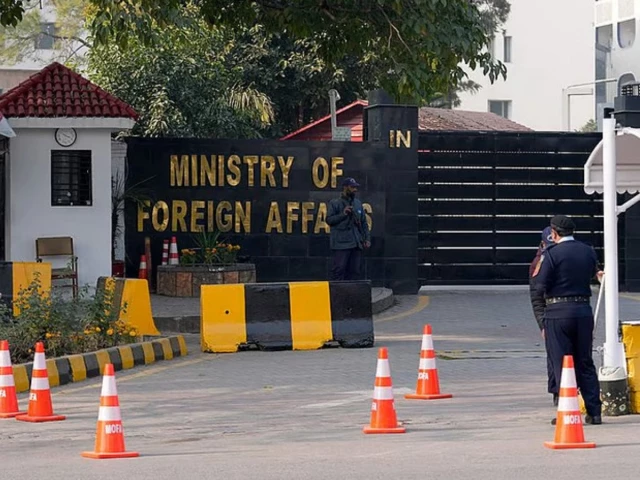
Police officers stand guard at the main entrance of the Ministry of Foreign Affairs in Islamabad. Photo: File
The Foreign Office (FO) on Monday rejected what it called “irresponsible and ill-informed insinuations” by some members of the UK diaspora regarding Azad Jammu and Kashmir (AJK) amid unrest in the territory.
The statement follows deadly clashes in AJK’s Rawalakot, where the recently banned Joint Awami Action Committee (JAAC) had staged a sit-in outside the CMH Rawalakot hospital. AJK police claim that armed JAAC members opened fire on deployed law enforcers in a planned attack, leaving four people dead and around 20 injured. JAAC, however, disputes this account and claims that security forces used tear gas and fired grenades at the hospital.
The British Parliament’s all-party parliamentary group on Kashmir wrote a letter to the foreign secretary on Saturday signed by 31 lawmakers expressing concern over the case and calling for action. Meanwhile, overseas Pakistanis and Kashmiris have also criticized the ongoing events.
In a strongly worded statement issued today, the MoFA said that these persons in the diaspora were advised to refrain from interfering in the internal affairs of Pakistan and AJK, adding that they “would do well to contribute positively to their country of residence.”
🔊 PR no. 1️⃣4️⃣3️⃣/2️⃣0️⃣2️⃣6️⃣
Pakistan rejects unjustified remarks on Azad Jammu and Kashmir
🔗⬇️ pic.twitter.com/8kKJgGOd4f
— Ministry of Foreign Affairs – Pakistan (@ForeignOfficePk) June 8, 2026
The statement also noted “baseless remarks and queries” raised by certain UK MPs, saying they reflected “a lack of awareness and ignorance of the historical background of the issue”.
It added: “For those still living in the colonial era, it bears repeating that Pakistan is a sovereign and democratic republic that fully believes in non-interference in the internal affairs of other countries and expects the same from others.”
The FO said the governments of Pakistan and AJK “recognize and fully respect the constitutional rights of citizens to peaceful assembly, freedom of expression and democratic participation”.
But it stressed that “vandalism, destruction of public services, including hospitals, and murder of innocent civilians and law enforcement officials cannot be allowed under any circumstances.”
It further called on the UK government to “educate and warn those who support proscribed organizations to refrain from such acts” and to respect “the democratic process, judicial decisions and the rule of law as enshrined in the constitutions of Azad Jammu and Kashmir and Pakistan”.
Read: AJK Police Says 3 JAAC Members Killed In Rawalakot Clash, Several Injured
According to the AJK police, three people associated with JAAC and four policemen were killed during the protests on Sunday. However, JAAC said in a statement on the X that seven people were killed and dozens were injured when street shelling was carried out in the dark after power was reportedly cut.
The clash on Sunday came as the AJK government and the JAAC witnessed a face-off when the election date for AJK was announced on July 27.
AJK’s 53-member legislature includes 12 seats reserved for Kashmiri refugees – people who fled Indian-controlled Kashmir in 1947 and 1965 and are now spread across Pakistan. Six seats represent refugees from the Jammu division (~434,000 people) and six from the Kashmir Valley (~30,000 people) – an already lopsided arrangement that many see as unfair.
The region experienced one of its most turbulent periods last October, when protests led by JAAC broke out over demands for constitutional and government reforms. At least nine people, including three policemen, were killed during the unrest.
JAAC, which organized the protests and strike, had presented a comprehensive charter of demands, including an end to the privileges enjoyed by the ruling elite, the abolition of 12 assembly spaces reserved for refugees and the abolition of the quota system.
Two days after the violence, the government and JAAC reached an agreement covering 12 core points and 13 additional points. Under the agreement, both sides agreed to set up a high-level committee to look into the issue of refugee seats in the AJK Legislative Assembly.
Read more: Four policemen martyred, over 20 injured in Rawalakot firing: AJK Police
The unrest also triggered political upheaval in the region. The Pakistan Peoples Party (PPP) subsequently moved a no-confidence motion against the then Prime Minister Chaudhry Anwarul Haq, with the Pakistan Muslim League-Nawaz (PML-N) participating in the effort. Haq, who had been elected in April 2023 with 48 votes, chose to face the vote rather than resign.
On 17 November, Raja Faisal Mumtaz Rathore secured 36 votes in the election and became the 16th Prime Minister of Azad Jammu and Kashmir.
With elections now approaching and the refugee seat issue still unresolved, the AJK government convened an All Parties Conference (APC) in Muzaffarabad to build consensus. Almost all major parties participated – except PTI and JAAC, which boycotted it.
JAAC’s position is that the government had already rejected its written proposal submitted on May 30, so it would be futile to participate. It had proposed either to retain token refugee representation until the Kashmir dispute is permanently resolved, or to replace the 12 seats in the Assembly with 4 seats in the AJK Council – a body headed by the Prime Minister, which it argued would better preserve the political dimension of the Kashmir issue.
The APC rejected any change outside the constitutional and legislative framework, saying only the elected assembly could change refugee seating arrangements. The JAAC called the resolution “a page and a half of completely trivial lines” and accused participants of coming together to serve their own interests rather than those of the public.
JAAC called for a major protest on June 9 in Muzaffarabad, where caravans are converging from across the region.
Minister for Parliamentary Affairs Dr. Tariq Fazal Chaudhry on Sunday rejected allegations that the agreement with JAAC had remained unimplemented, saying the government had fulfilled the vast majority of its obligations in AJK.
The minister warned against attempts to foment unrest in AJK and questioned whether such actions served the interests of Pakistan, AJK or the wider Kashmir cause. “The solution to these issues is not violence,” he said, adding, “The solution is dialogue. We cannot allow law and order to deteriorate or innocent lives to be lost.”


