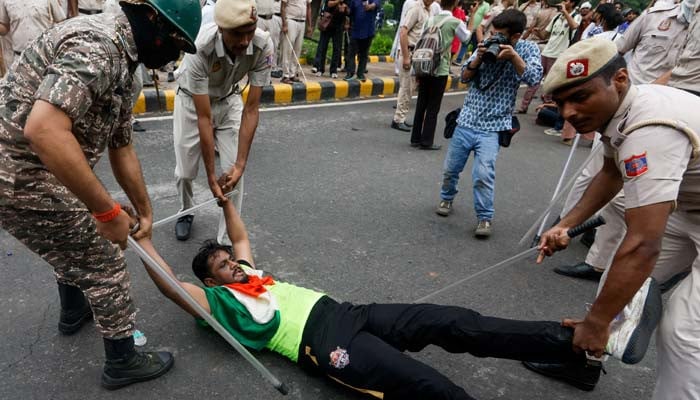
A steady stream of food delivery riders carrying meals, snacks and bottled water is helping to sustain a youth-led protest movement that has emerged in the heart of India’s capital.
Motorcycles weave through traffic before pulling up next to clusters of volunteers, sending donations from supporters across India and abroad unable to attend in a rare display of public dissent against Prime Minister Narendra Modi’s government.
“From Kerala to the US, orders are coming from everywhere,” said rider Suraj Kumar, 25, sitting atop his motorcycle with a bag of kachoris, a popular deep-fried snack, as some volunteers climbed over police barricades to receive the packages.
A volunteer took the package and passed it hand in hand towards the center of the protest site a few hundred meters away around Delhi’s Jantar Mantar observatory, where hundreds of people gathered around a raised platform.
There, leaders of the Cockroach Janta Party (CJP), a movement that began as online satire in May, demanded the resignation of Education Minister Dharmendra Pradhan over repeated leaks of test papers. They have been there since last month, but the protest only gained momentum in recent days after a prominent activist began an indefinite hunger strike in support.
Protest supported by ‘people’s kindness’, says student
The camp has persisted despite a major police crackdown on Monday, when tens of thousands of mostly young people tried to march on parliament. Indians under 30 are estimated to make up more than half of the country’s 1.42 billion people, and many have long complained that years of strong economic growth have not created enough jobs.
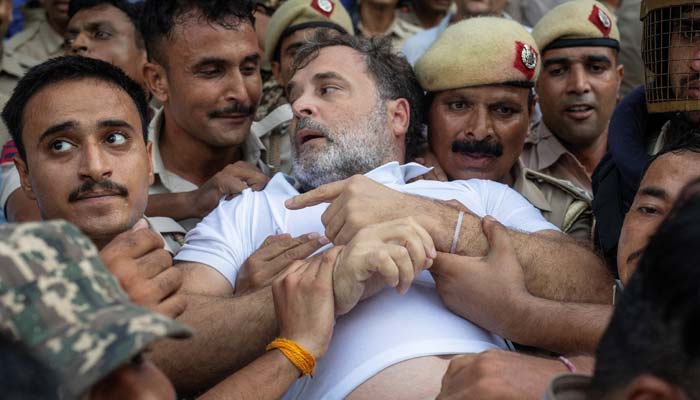
“People are angry, especially after the police started beating innocent students. But not everyone can come here, so they send food,” said Raj Rathore, 25, a volunteer who has spent the past few days unloading and distributing supplies, including water bottles, fruit and crackers.
Those contributions, along with volunteer support networks, have helped keep the protest running around the clock, students said.
“This protest is running purely because of people’s kindness and the fact that we are all united,” said Rina Rawat, a student at Delhi University who is herding people in queues inside the protest site.
Rawat, 20, was beaten on his left leg by police batons on Monday but returned the next day to “do his duty”, she said.
Protest offers rare open criticism of Modi
Modi has not directly commented on the protests, although a minister said after a meeting of the ruling coalition that the prime minister had told them that the “strongest possible steps are being taken to protect the interests of the students”. Pradhan promised “answers, reforms and accountability”.
At the protest site, the number of protesters swelled to 5,000 by late afternoon on Wednesday, despite intermittent monsoon showers. Most were Gen Z students carrying placards, blasting patriotic Bollywood songs and chanting slogans.
“Modi, we will not tolerate your autocracy,” shouted one protester as the crowd cheered, a rare sight under a leader who has dominated Indian politics since taking power in 2014.
“I was a Modi supporter till 10 days ago,” said Mukesh, who declined to give his second name. “But when I saw the brutality of the police, I was shocked.”
Young doctors, medical students provide first aid, medicine
Volunteers cleared puddles and collected trash, while others used hand-held fans to keep protesters cool in the humidity.
A medical booth staffed by volunteer doctors and medical students has been operating at the site for about a month. Volunteers said they had been particularly busy the past two days.
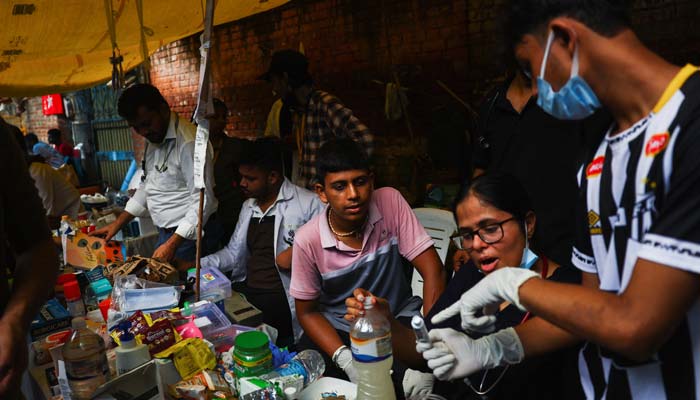
“We provide first aid and medicine for dizziness and nausea,” said Bhavna, 23, who did not want to share her last name. “We’ve also suffered because of paper leaks; the anxiety that gives you is enormous.”
Many protesters drew inspiration from India’s independence movement, carrying portraits of revolutionary Bhagat Singh, holding copies of the constitution and handing out roses. Others donned Spider-Man masks and held slogans describing themselves as “villains”.
Nearby, 19-year-old Arpita Verma said “there has been too much Hindu-Muslim politics in India”, referring to sharper religious divisions under Modi’s party, which draws support mainly from the Hindu majority.
“But we have no room for this – now we are united by a common cause, and we are not afraid at all.”