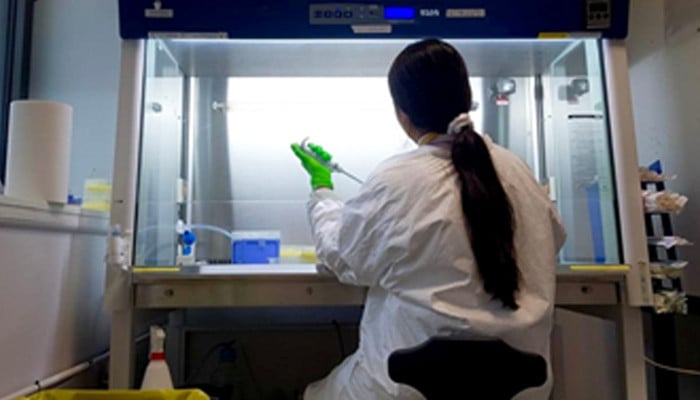
The Cancer Research Center of Lyon (CRCL) is a leading oncology institute established in 2011 in Lyon, France, created to promote the translation of basic research. The center is organized into five primary interrelated categories. Sabreena Khan, a 26-year-old Pakistani woman, works at this well-known institute in their immunology department, developing treatments that harness the immune system.
She is currently sitting in her laboratory, wearing a white coat, in Lyon, France. She is one of the only Pakistanis working at a leading cancer institute focused on supporting the development of translational cancer research to rapidly bring scientific breakthroughs to patients. To understand her journey, one must go back several years to a simple question she was often asked: “What is your favorite subject?” Her answer was always: “Biology.”
Born and raised in Pakistan, Sabreena left home at the age of 19 to pursue her bachelor’s degree from South Korea in bioengineering. While pursuing her degree, she was particularly drawn to bioengineering applications in oncology, which eventually led her to further pursue a Masters in Cancer Bioengineering in France. For her, understanding how the immune system interacts with cancer cells felt both intellectually challenging and deeply impactful.
Sabreena decided to move to France because of its strong research infrastructure and focus on scientific innovation. “It wasn’t easy to get here,” she recalls. “I knew I wanted to contribute to something meaningful and that made me explore opportunities abroad,” says Sabreena Khan. Her internal compass guided her along a path where she navigated through complex applications, funding and adapted to a completely different academic and cultural environment, each step reinforcing her motivation. “Today, as a graduate student doing my thesis, I am exactly where I am meant to be,” states Sabreena. She was extremely grateful and happy to receive a scholarship and go to France.
But even with such a strong sense of belonging, success does not come easily to her. Research is demanding, the hours are long, and sometimes things don’t work out with the constant pressure of perfection and bringing in meaningful results. Furthermore, the language barrier limits administrative and social interactions, which initially made her feel isolated. At social events, dinners or lunches, most conversations are mainly in French and so she would stand alone and look at people’s faces instead of actually socializing with anyone. Therefore, she gradually began to learn French, one sentence at a time. When asked what really motivates her despite such challenges, her answer is simple but meaningful: “The purpose behind my work.” Cancer affects millions of lives and she believes that her small contribution can play a vital role in someone’s treatment.
Cancer vaccines are an exciting frontier in oncology. “Cancer vaccines strengthen the immune system’s ability to fight cancer.” Her work particularly focuses on immunotherapy and cancer vaccine approaches that harness the immune system to fight cancer more effectively. “The idea that we can reprogram the immune system to recognize and destroy cancer cells is incredibly powerful,” she enthuses. This is important because with this we can eradicate cancer completely. Cancer kills 10 million people every year and this research is essential to eradicating it completely. “Whether it’s studying cell behavior, immune responses, or the tumor environment, each piece of data adds to a larger puzzle.”
In addition, her journey has quietly also been shaped by society’s expectations. As a Pakistani, it was not easy for her to reach this point. A close relative once jokingly told her, “Oh, so you want to fix machines in a hospital.” The comment stung and reflected common misconceptions about biomedical engineering. In Pakistan, women are often asked to pursue traditional career paths such as teaching or medicine, while fields such as biomedical research are not widely encouraged, let alone the idea of moving to France for cancer research. But even after all these comments, her family pushed her through and was her main driving force. For young girls in Pakistan who want to follow a similar path, she emphasizes readiness for challenges and sees them not as barriers but as part of the journey. “Every experience, good or bad, shapes you into a stronger scientist and individual,” she states with confidence.
Also, preserve its Pakistani identity and represent it in a global forum with meaningful contributions. “I wear my identity with pride. Being a Pakistani woman in a global research environment allows me to bring in new perspectives.”
Also, the social interactions between people are completely different as they move from East to West. Although she had experience living abroad, she still has problems, and it was a big step for her to move from the East to the West. France and Pakistan have different social structures. “It required me to adapt to a more individualistic culture and relearn everything—from how colleagues interacted to how professors gave feedback.” These unfamiliar social norms made Sabreena feel alienated at first. During the interview, she mentions that in France people are far more direct than she was used to. “I found the transition very scary at first,” she recalls. As a result, she had to navigate the process of preserving her own cultural values while integrating into a new society. She needed to find her own equilibrium – not to choose one culture over another, but to balance them both. “I had to stay true to myself while being open to change.”
“Now I’ve learned to be more resilient above all else.” Looking at the bigger picture, for her, not everything goes as planned. From failed experiments to completely forgetting to record experimental results, to destroying an entire batch of human cells, she faced several moments of doubt. But each setback has taught her something valuable, giving her the strength to push through trials and challenges.
Her advice is straightforward: “Don’t let fear hold you back. The process can seem overwhelming, but it is absolutely possible. Be persistent, seek guidance and believe.”
As Sabreena beautifully puts it: “Trying is everything, because the moment you try, you create the possibility for change. Without it, nothing moves, nothing grows, nothing comes into being.”
Her journey doesn’t just end here; she plans to continue her education and research in immunology. After earning his master’s degree, “I hope to continue my academic journey through a PhD in cancer research and eventually bring the knowledge, experience and research skills I gain to Pakistan.” Her main goal is to contribute to strengthening cancer research. “I want to be able to make advanced scientific approaches more accessible in my country,” she says firmly.