
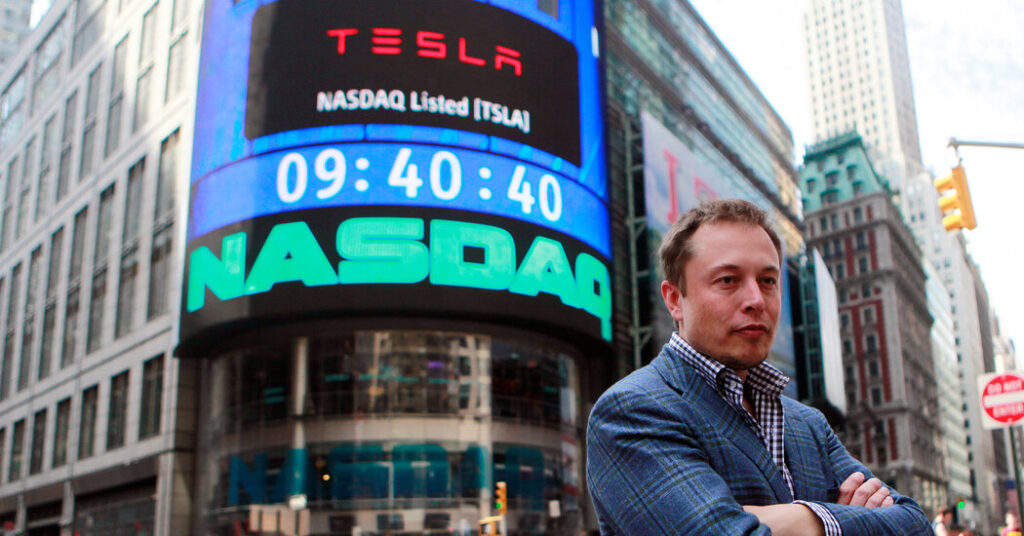
Tesla had sold just under 1,000 cars when the company’s CEO, an up-and-coming entrepreneur named Elon Musk, rang the opening bell on Nasdaq in June 2010.
The initial public offering valued Tesla at $1.7 billion, even though the company’s only product was its two-seat Roadster, which had a starting price of $100,000 and took seven hours to charge. Some prominent Wall Street figures were deeply skeptical.
“Tesla is selling, selling, selling,” CNBC host Jim Cramer told viewers. “You don’t want to own this stock.”
Tesla and Mr. Musk has come a long way.
Now he is asking investors to value SpaceX, where he is also CEO, at $1.77 trillion, or more than a thousand times what Tesla was worth in 2010. The SpaceX listing is expected to raise $75 billion for the company. Tesla’s IPO raised $226 million, far less than it had received in federal government loans.
Mr. Musk is much better known than he was in 2010. As the world’s richest person, he has become a lightning rod for anti-billionaire sentiment. He owns the social media site X, which he uses to broadcast right-wing political views.
But the Tesla IPO and the stunning rise in the share price in recent years helped to create an aura of mystery surrounding Mr. Musk. To his many admirers on Wall Street and in Silicon Valley, he is a genius who has made loyal investors insanely wealthy while disrupting the auto and aerospace industries.
An investor who bought 1,000 Tesla shares in 2010 at the initial public offering price of $17 and held the shares until now would have made a profit of more than $5.8 million. The spectacular returns have enabled SpaceX’s “massive valuation,” said Michael Lenox, interim dean of the Darden School of Business at the University of Virginia.
“‘We trust Elon,’ said Mr. Lenox and summarized Mr. Musk’s view among his admirers. “He’s created these successful companies. That’s what the market is looking at.”
Even in 2010, Mr. Musk’s brashness and talent to win over investors.
Dismissing criticism from Mr. Cramer, Mr. Musk reminded viewers that the Wall Street guru had also recommended buying shares in Bear Stearns before the Wall Street bank collapsed during the financial crisis. Mr. Cramer, said Mr. Musk, with a smile during an interview with CNBC, was a “counterindicator.”
“The smartest money in the world is betting on Tesla,” he told Bloomberg in another interview, without naming any investors. “They must have some reason.”
Mr. Cramer wasn’t entirely wrong. Tesla shares languished for nearly a decade, trading below the offering price well into 2019. They began to take off after the company’s Model 3 began selling in significant numbers.
Mr. Cramer later changed his mind about the fledgling automaker, which became the largest maker of electric vehicles until China’s BYD overtook it last year.
“Tesla was a very speculative company when it went public, and I was skeptical,” he said this week in a statement to The New York Times. “As the company proved it could execute and the facts changed, my view changed.”
In 2010, it was by no means certain that Tesla’s stock would succeed. Inside the company, employees were anxious, said Kurt Kelty, who was Tesla’s senior director of battery technology. “What will happen to the price of the stock when it goes public?” he said they had wondered. “Are we going to tank on the first day? Are we going to take off like a rocket?”
Mateo Jaramillo, who was working on Tesla’s electronic propulsion systems at the time, said he and other workers had been too busy to spend much time celebrating. “Maybe we took an hour or two to acknowledge the event and then it was right back to work,” he said.
Tesla employees had stock options, but at the time they didn’t seem much more valuable than the bottles of “Roadster Red” wine they had received as a memento of the IPO.
“We all believed in the company or we wouldn’t have been there,” said Mr. Jaramillo, now CEO of Form Energy, a company that makes large-scale energy storage systems. “But none of us went there with the expectation that it would be some kind of wealth-creating endeavor.”
It was an unfortunate time for the automotive industry. General Motors was emerging from bankruptcy and Ford Motor sold Volvo at a loss after selling Jaguar Land Rover.
There was really no market for electric cars. The Model S sedan, Tesla’s first mass-production car, wouldn’t hit the road for another two years.
“There were still a lot of questions about electric cars and whether they were viable,” said Mr. Lenox, whose research at the University of Virginia focuses on technology companies.
Mr. Musk won over investors by portraying Tesla as a Silicon Valley start-up with huge growth potential, the opposite of the stodgy, century-old Detroit automakers.
“We operate in a fundamentally different manner and structure than traditional automakers,” Tesla’s 2010 prospectus said.
Musk still tells shareholders that Tesla is much more than a car company. Now he argues that it will dominate the market for self-driving taxis and humanoid robots, untested technologies that do not generate much revenue. Enough investors are buying that premise to give Tesla a stock market valuation of $1.4 trillion, many times the valuation of GM and Ford.
He has also pitched SpaceX as more than just a rocket company or a provider of satellite internet services. It will also build orbiting data centers to power xAI, its artificial intelligence unit, and take humanity to Mars, he has said.
SpaceX’s mission is “to build the systems and technologies necessary to make life multiplanetary, to understand the true nature of the universe and to extend the light of consciousness to the stars,” the company has said in investor presentations.
No one can say for sure how SpaceX stock will perform and whether it will follow the trajectory of Tesla stock. Even executives who spent years at the automaker admitted they hadn’t anticipated its rise.
“Who would have known how high the stock has gone,” said Mr. Kelty, now vice president in charge of batteries at GM, on Tesla’s shares. He added: “I wish I had hung on to mine.”


