
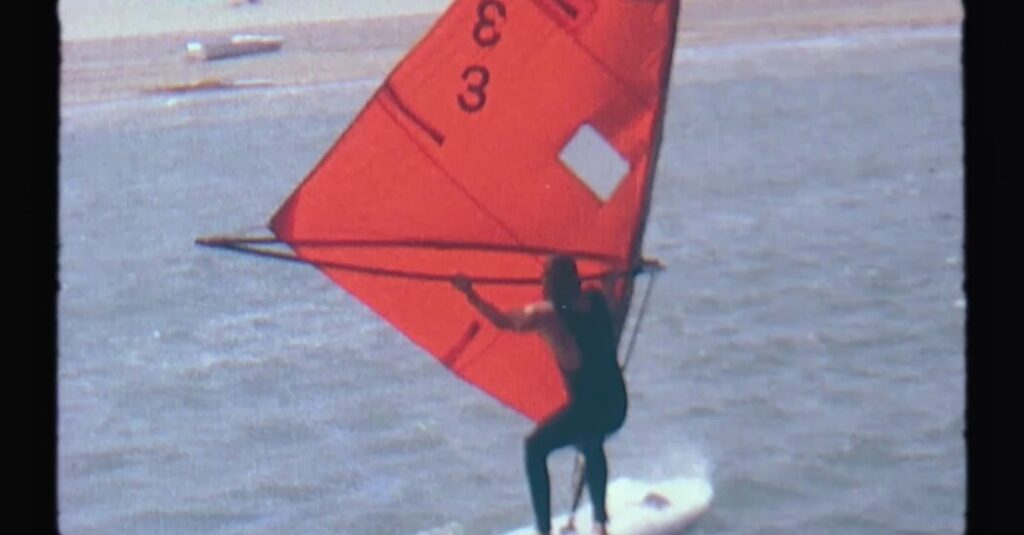
Hoyle Schweitzer, a surfer and sailor who turned a garage experiment into a global sport when he and a friend, Jim Drake, developed the Windsurfer, a windsurfing board that made it possible to glide across lakes and rough seas, died May 31 in San Marcos, California. He was 93 years old.
The death at a nursing home was confirmed by his daughter-in-law Shawneen Schweitzer.
Mr. Schweitzer, who worked in the nascent computer industry, and Mr. Drake, a sailor and aeronautical engineer, patented the design for what became the Windsurfer in 1970. Working out of Mr. Drake’s Garage, they created a board that had an asymmetric sail and a hand-held wishbone boom, which allowed riders to run over the water – or even be too turbulent – or even run over the water. conventional surfing. A cardan joint made it easy to release the sail and pull it up again.
Mr. Schweitzer and Mr. Drake called their creation the SK8 and the Baja Board before settling on the name Windsurfer.
Their sailboard, which was cheaper and more portable than most sailboats, made the water accessible to more people. It turned the smooth surface of a lake into an exciting place for racing and allowed surfers to ride on windy days when the sea was rough and the waves unpredictable.
Surfers found it useful as a training tool, helping them tackle previously unapproachable waves. “Windsurfing really helped me when I started pulling big surf,” Laird Hamilton, a famous big wave surfer, said in “Broken Molds,” a 2021 documentary.
Windsurfing’s popularity also helped give rise to other water sports, including kite-surfing and foiling.
Mr. Schweitzer and his wife, Diane, started a company called Windsurfing International to mass-produce the boards and mortgaged their house to raise money for the business, his daughter-in-law said. Around 1973, Mr. Schweitzer bought Mr. Drake’s share of the patent for $36,000 (about $280,000 today).
By the late 1970s, windsurfing had become hugely popular in Europe; in 1984 it became an Olympic sport.
Mr. Schweitzer “challenged conventional thinking, expanded access to the sport and helped shape many of the high-performance disciplines we see today,” said Gary Jobson, an America’s Cup winner and former president of US Sailing, the national governing body for sailing.
Henry Hoyle Schweitzer was born on April 8, 1933 in Los Angeles to Jacob and Phoebe (Hoyle) Schweitzer. He grew up surfing and sailing in Southern California and on Cape Cod, Massachusetts, where he visited an aunt in the summer.
At Pomona College, he spent his free time shaping boards with future Hall of Fame surfer Gordon Clark. He graduated in 1955 and married Diane Pardue the next year.
The origins of windsurfing have often been debated. While Mr. Schweitzer popularized the sport, he and Mr. Drake were not the first to come up with the idea of attaching a sail to a board. Others included Peter Chilvers in Britain in the 1950s and S. Newman Darby in Pennsylvania in 1964. Their efforts revived in the 1980s when windsurfer imitators appeared and Mr. Schweitzer began defending his patent in court.
Mr. Chilvers had made his board out of plywood, curtain rings and a tent cover when he was 12. The British courts recalled Mr. Schweitzer’s patent in England, but it was upheld in the United States, where Mr. Darby never secured a patent for his invention, despite manufacturing and selling his boards and publishing an article about his design in Science magazine in 1965 in Popular Science in 1965.
After Mr. Schweitzer’s patent expired in 1987, the Schweitzers decided to close their business. Without the revenue from license fees, Mr. Schweitzer told American Windsurfer magazine in 1996, “we couldn’t afford to keep the doors open anymore.”
When the Schweitzers retired, they bought a yacht and sailed around North and Central America. In 2020, they were inducted into the National Sailing Hall of Fame in Newport, RI; the next year they were inducted into the Windsurfing Hall of Fame. In recent years they lived on Maui, Hawaii.
Mr. Schweitzer is survived by his wife; a daughter, Tara Clawson; two sons, Ted and Matt, an 18-time world champion windsurfer; five grandchildren, including Zane Schweitzer, a multi-discipline professional surfer; eight great-grandchildren; and a sister, Laurie Brown.
For windsurfers like Robby Naish, who came of age as the sport grew in popularity, Mr. Schweitzer’s legacy has less to do with who first put a sail on a board than with the culture he and his wife helped build around windsurfing.
“Hoyle is really the guy who deserves the credit for making a sport out of it,” said Mr. Naish, a 24-time world champion, often called the king of windsurfing, in an interview. Mrs. Schweitzer, he noted, also deserved credit.
As Mr. Naish said in the 2021 documentary, “It wasn’t just putting a surfboard and a sail together. It was putting the surfboard and the sail together and then making something out of it.”


