
- Huawei promises annual AI chip leaps, while rivals still follow slower development cycles
- Nvidia now faces a rival accelerating infrastructure expansion
- Huawei already operates large computing clusters that support millions of connected vehicles
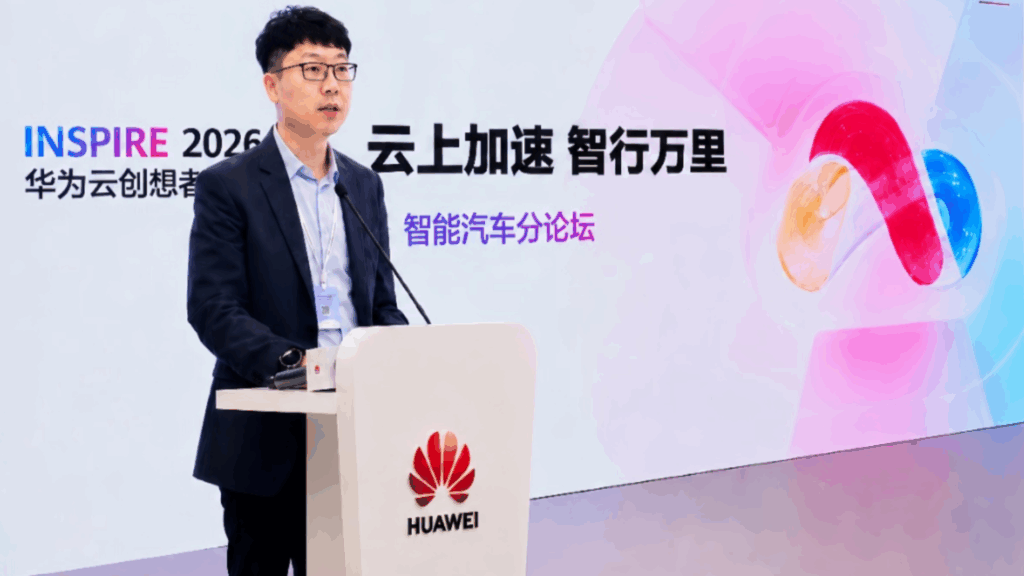
On June 5, Huawei Vice President Chen Lin spoke at the 2026 Huawei Cloud INSPIRE Innovators Conference, where all eyes turned to one announcement – the Ascend 950DT chip arriving in Huawei Cloud later this year.
The 950DT has upgraded vector computing power, wider memory bandwidth and built-in support for low-precision formats such as FP8.
According to Chen, the chip is simpler to program and better suited for intelligent driving than anything before it, but what Chen said next deserves far more scrutiny than the chip itself — especially for rivals like Nvidia

One generation a year, computing power doubled every single time
“The Ascend chip is developing at a rate of ‘one generation per year, doubling the computing power,'” Chen said without reservation or disclosure.
It’s a public commitment to a release cadence aggressive enough to challenge how AI chip progress is measured.
Nvidia has long controlled that pace, with each new architecture raising the bar for every competitor that chases it — and a rival locking in annual generational leaps — publicly on a stage — doesn’t act like a company that’s still catching up.
Whether Huawei can maintain that pace without advanced Western lithography tools remains a fair and open question.
The advertised cadence only carries weight because there is a real infrastructure behind it.
Huawei Cloud has deployed large-scale computing clusters across Gui’an, Wuhu and Inner Mongolia with a global network covering 34 regions and 102 availability zones.
Over 100,000 Ascend computing devices currently support continuous algorithm iteration for paying customers via Huawei Cloud.
Every day, more than two million intelligent driving vehicles and 60 million connected vehicles run stably on the same infrastructure. These are operational numbers, not projections from a roadmap slide.
More than 30 automotive OEMs and suppliers have built deep partnerships with Huawei Cloud across intelligent driving and intelligent manufacturing.
The growing customer base absorbs each new chip generation as it lands, giving Huawei a live test bed that sharpens each subsequent release.
Changed from usable to really easy to use
Huawei’s comment moves beyond the hardware specs and into something more difficult to address quickly.
Chen emphasized that systems engineering capabilities are as crucial as raw computing power to help automakers improve the effectiveness of intelligent driving training.
Through its Lingqu architecture, Huawei Cloud achieves high-speed connectivity within supernodes, which meaningfully improves training efficiency at scale.
Its AI DataLake platform supports the production of hundreds of thousands of data clips every single day.
Huawei Cloud has also worked directly with leading manufacturers of intelligent driving across the entire model iteration cycle – from integration of computing power to algorithm adaptation and optimization.
That level of deep involvement transforms Huawei from a chip supplier to an integrated infrastructure partner.
The stated ambition, in Chen’s own words, is to go from chips that are only “usable” to a full stack that is truly “easy to use.”
Via Guancha (originally in Chinese)

Follow TechRadar on Google News and add us as a preferred source to get our expert news, reviews and opinions in your feeds.


