
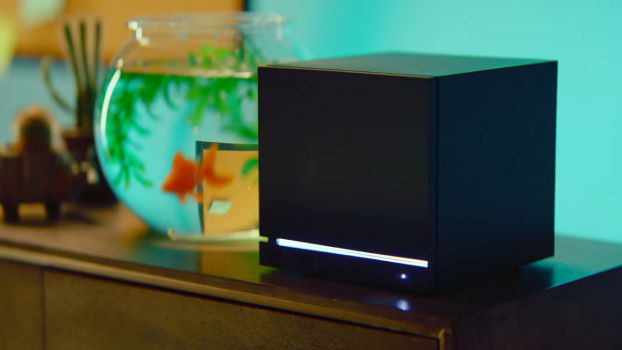
- There is a hidden twist with the configuration of the Steam Machine’s RAM
- Most units have a single 16GB stick, but some have a pair of 8GB modules
- A single or dual configuration might not make a big difference in many cases, but it might in some scenarios – and some players really aren’t happy about this
You might be aware that the Steam Machine has 16GB of RAM, but what you might not know is that it’s likely to be present as a single stick of 16GB of DDR5 memory rather than the preferred configuration of twin 8GB sticks – although you might get the latter.
Confused? I’ll come back to that wrinkle in a moment, but in the main it seems most Steam machines have the single 16GB loadout, which, as Digital Foundry explains, is due to Valve having difficulty securing 8GB memory sticks.
As Steam Machine engineers Pierre-Loup Griffais and Yazan Aldehayyat said in an interview, “It was literally impossible to buy 8GB [sticks]at least in the quantities we’re looking to buy, mostly because everybody wants higher storage and it’s more profitable, so all the capacity moved to that.”

In short, it was either go with 16GB sticks for the most part – which were plentiful – or shelve the Steam Machine project.
Why is a pair of 8GB RAM modules better? Because it makes using dual-channel memory – essentially both sticks working in parallel – a performance boost you obviously can’t get with just one stick. So your next question is probably: how much of a difference is there?
Of course, a dual-channel setup is nothing like twice as performant for gaming, but there is a (situational) boost, although Valve’s engineers claim that it is largely unnoticeable with DDR5 memory.
Aldehayyat says these two configurations (single or dual) are “fairly comparable” in actual games, unlike some benchmarks where weaknesses can show up in a more pronounced way for the individual stick.
In fairness to Valve, it’s true that in many gaming scenarios with the Steam Machine, having all your DDR5 RAM in one block won’t make any real difference, at least not one that’s noticeable in terms of the smoothness of your gaming experience. This applies especially at higher resolutions, where e.g. 4K puts a lot of the workload on the shoulders of the GPU.
However, in games that are more demanding on the CPU, this is less true, and you may find that the single stick configuration is a drag on performance, possibly hitting you with more stutter (dropping to much lower frame rates more often).
As Digital Foundry points out, an increasing number of games tax the CPU, especially heavyweight open-world titles such as Crimson desertor the like Baldur’s Gate 3 or Cities: Skylines.
Analysis: single or double lottery – although there is actually an advantage to the latter as well

Let’s get back to the RAM lottery twist I mentioned at the start, which is that, as explained by Griffais in a separate Gamers Nexus video (which was flagged by Wccftech), some Steam machines have a few 8GB sticks (if this memory was available in certain regions at the time of production – and it doesn’t sound like it was in many cases).
There may be an advantage to the single 16GB loadout, mind you, and that is if you intend to upgrade the RAM in the future. With an extra memory slot, you can buy another 16GB stick to easily double up to 32GB – but if you have two 8GB sticks, it can’t be done (you’ll have to buy two 16GB modules and completely replace the existing ones at a greater cost).
So if you’re worried about all this, should you open your Steam Machine to check your RAM configuration with a view to switching to a pair of 8GB sticks if you have a single 16GB module (while selling the latter)? I don’t think that’s a good idea, because for starters Digital Foundry makes it clear that getting to the RAM and replacing it “requires significant disassembly of the machine” and possible risks involved. It’s certainly not something a relative tech-novice will attempt, and frankly the benefit of switching to a dual-channel setup (if you have a single RAM stick) isn’t really worth all the trouble.
Overall, this is a less-than-ideal situation, between the single stick performance catch and the RAM lottery aspect, where you can’t tell which hand you’ll be dealt with your Steam Machine.
Unfortunately, Valve hasn’t had much choice in the matter thanks to the memory crisis. Of course, ruling out using dual sticks in some cases would have further limited supply when the situation is already bad enough to have forced the price of the entry-level Steam Machine over a grand.
So once again, thanks to the giant memory hoover that is AI, PC buyers are getting the short end of the RAM stick (to put it politely).
Predictably, many players are not happy to learn about this. One Redditor complains: “This is absolutely terrible. They’ve done what dodgy prebuilds do, which is have a single stick of single-channel memory that affects CPU performance.”
Another deflated Redditor simply says, “This whole Steam Machine thing is the most depressing thing for me in the last 7 months. It’s officially DOA.”
If this puts you off the Steam Machine even more, which comes on top of the steep MSRP attached to the device, you might want to consider buying an alternative PC on sale or actually building your own, which, to be fair to Valve, is something it’s encouraging.

Follow TechRadar on Google News and add us as a preferred source to get our expert news, reviews and opinions in your feeds.

The best pc controllers


