
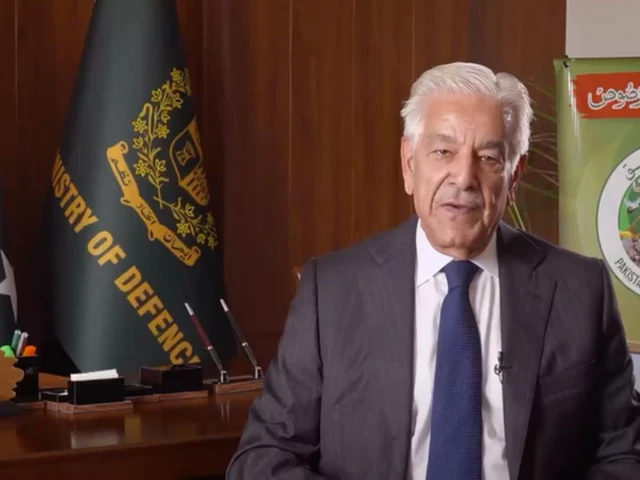
This was said by Defense Minister Khawaja Asif on Wednesday Marka-e-Haq has made it clear that any future aggression will be met with a far more intense and decisive response, Radio Pakistan reported.
On 13 May 2025, Prime Minister Shehbaz Sharif declared that 10 May will be observed annually as Youm-e-Marka-e-Haq to commemorate the “magnificent success” of ‘Operation Bunyanum Marsoos’ and to express national solidarity
In a video statement, the Defense Secretary said the retaliatory capabilities of the Army, Navy and Air Force are faster and more coordinated than the enemy can imagine.
He said the entire nation stands united with its armed forces like a wall of steel.
Asif said that the insight and self-confidence of Pakistani youth is the true strength of the nation and they know how to defend the country.
Tuesday spoke at the launch of a picture book with the title The Battle for Truth (Marka-e-Haq)released by the Ministry of Information and Broadcasting (MoIB) in collaboration with the Inter-Services Public Relations (ISPR), the minister said the entire nation stood united against any form of enemy aggression.
Read: Khawaja Asif praises armed forces, warns against future aggression
He said that Pakistan had emerged as a more stable and powerful country and had become a symbol of stability in the region. “We are ready for any kind of Indian proxy war,” he added.
The opening ceremony of the book “معركہ حق: دي بتل ترث” was held in collaboration with the ISPR.
ISPR کی تیم کی کے کے کے کے کے کے کے کے کے کے تحسین گان گ اج کی يه كامریم ایک اوکار و سہے کے کے ہیں pic.twitter.com/Vp3195ZAkW
— Ministry of Information and Broadcasting (@MoIB_Official) 5 May 2026
The minister said the Pakistan armed forces had foiled India’s “malicious designs” during Marka-e-Haq and successfully neutralized its S-400 air defense system.
He said no country in the region was safe from India’s Hindutva mindset, adding that it had repeatedly imposed wars on Pakistan to divert attention from its internal problems.
Pahalgam attack
On 22 April 2025, the escalation between Pakistan and India began when an attack in Pahalgam killed 26 people. India immediately blamed Pakistan for the incident. However, Pakistan categorically denied the Indian blame.
In response, India took a series of hostile actions the next day, on 23 April 2025, including suspending the 65-year-old Indus Waters Treaty (IWT), canceling visas for Pakistani nationals, closing the Wagah-Attari border crossing, ordering the closure of the Pakistan High Commission’s diplomatic staff in New Delhi, as well as other diplomatic embassies in Pakistan.
Tensions escalated further in the early hours of 7 May 2025 when missile attacks hit six towns in Punjab and Azad Jammu and Kashmir (AJK), destroying a mosque and killing dozens of civilians, including women, children and the elderly.
Read more: French intelligence confirms Pakistan downed Rafale
In a swift military response, Pakistan’s armed forces shot down Indian warplanes, including three Rafale jets. The confrontation intensified again in the early hours of 10 May 2025 when India targeted several Pakistani air bases with missile strikes. In retaliation, Pakistan launched Operation Bunyanum Marsoos, damaging Indian military installations, including missile sites, air bases and other strategic targets.
On 10 May 2025, US President Donald Trump announced that a ceasefire had been reached after intense diplomatic efforts overnight. Minutes later, the agreement was confirmed separately by Pakistan’s foreign minister Ishaq Dar and the Indian foreign minister.


