
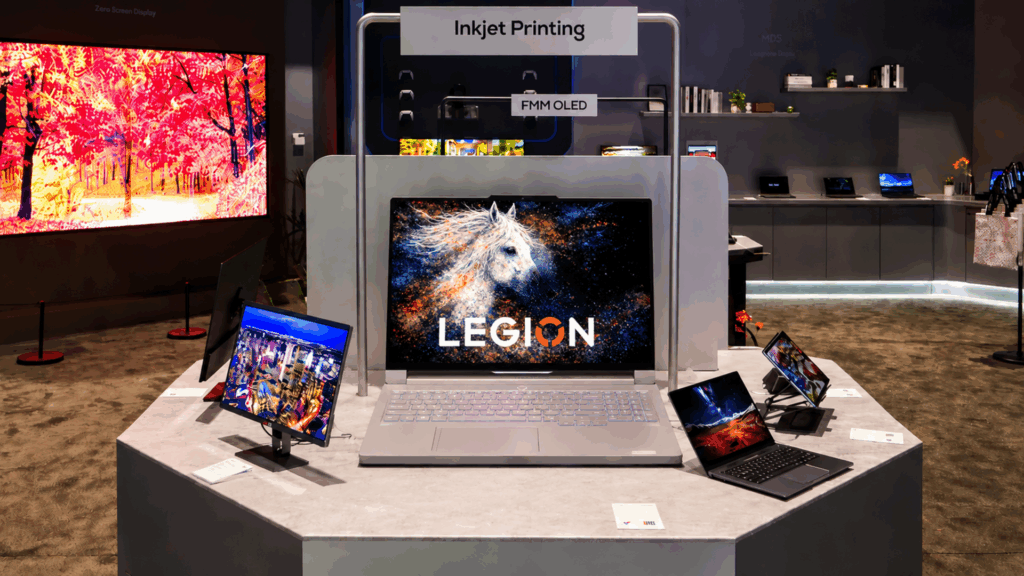
- Lenovo introduces the first laptop using TCL CSOT’s inkjet OLED panel
- Inkjet printing can reduce OLED production costs for future consumer devices
- The Legion R9000P combines gaming performance with a sharper OLED screen experience
Lenovo has launched the Legion R9000P as the world’s first laptop with TCL CSOT’s inkjet-printed OLED display technology.
The portable gaming laptop introduces a 16-inch IJP OLED panel designed to combine OLED image quality with a newer manufacturing process.
The launch marks the first commercial portable use of TCL CSOT’s display technology, which has been developed for more than a decade.

The Legion R9000P brings a new OLED experience to laptops
The Legion R9000P uses a 240Hz OLED display aimed at users who need smoother images during fast-moving gaming and entertainment content.
The panel covers more than 99% of the DCI-P3 color gamut, providing wide color reproduction for gaming, creative work and multimedia consumption.
Lenovo says the display maintains consistent color performance across brightness levels, helping it serve various usage scenarios beyond gaming.
The display also uses a Real RGB Stripe side-by-side subpixel arrangement, which solves text clarity issues found on some traditional OLED layouts.
This design improves image sharpness by reducing color fringing and blurred text that can affect productivity tasks on OLED panels.
The display technology may make the Legion R9000P appealing beyond gamers, including professionals seeking strong visual quality from laptops.
This is a budget device that could be used for a business laptop with premium display capabilities or even a student laptop with better visuals for demanding software.
Inkjet OLED could change future portable displays
TCL CSOT’s inkjet-printed OLED process differs from traditional vacuum-thermal evaporation methods commonly used in OLED manufacturing.
The company uses inkjet printing to create organic light-emitting material layers, reducing reliance on expensive equipment and fine metal meshes.
This simpler production approach can improve production efficiency and increase yield, potentially lowering costs as the technology matures.
TCL CSOT has been working on IJP OLED development for over 10 years, gradually expanding the technology towards commercial applications.
In November 2024, the company’s 5.5-generation IJP OLED production line in Wuhan entered mass production and delivered its first product.
The company later announced the construction of an 8.6-generation IJP OLED production line, marking another step towards larger production.
TCL CSOT says the technology maintains OLED advantages such as high contrast and strong color performance while supporting wider applications.
Beyond laptops, the company expects inkjet-printed OLED panels to eventually reach displays, televisions and smartphones.
If manufacturing costs come down, the technology could help bring higher-quality OLED displays to more affordable devices, including future budget laptop models.

Follow TechRadar on Google News and add us as a preferred source to get our expert news, reviews and opinions in your feeds.


