
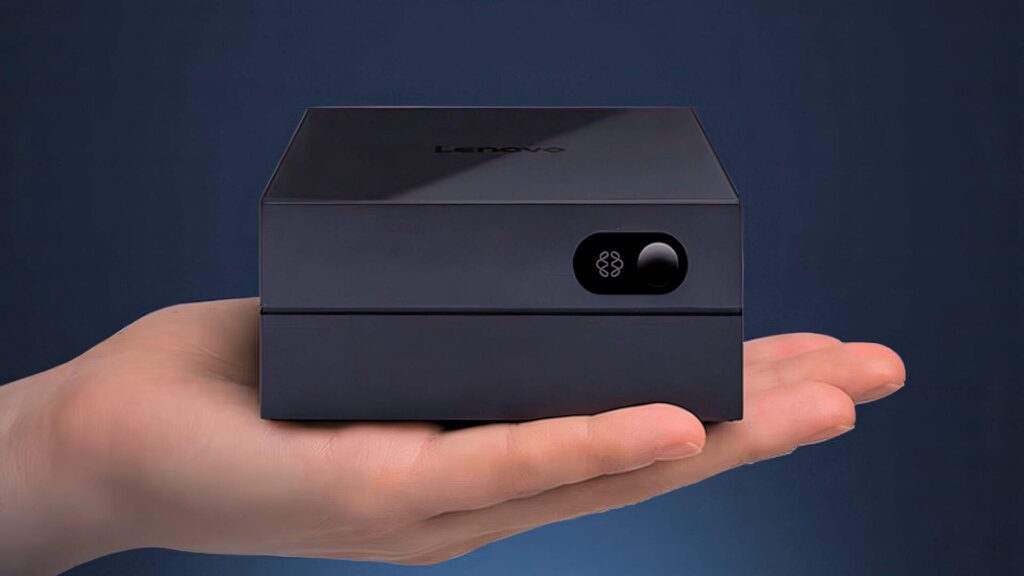
- Lenovo replaces traditional applications with thousands of downloadable AI functions
- Lenovo AI Host Mini comes with access to over 8000 skills
- Lenovo’s proprietary marketplace is at the center of the experience
Lenovo has launched a mini PC that replaces much of the traditional software model with artificial intelligence features that can be downloaded from its own marketplace.
The company says users can access more than 8,000 AI skills instead of relying solely on conventional desktop applications and services.
Unlike conventional software stores run by third parties, these AI features are distributed through Lenovo’s own proprietary marketplace integrated into the Tianxi Claw platform.

A computer built around downloadable AI functions
AI Host mini can be configured by scanning a QR code with a smartphone before activating additional functions via the Skills marketplace.
After completing the configuration process, users can deploy AI tools through the Skills system.
Lenovo says the platform comes with more than 20 pre-installed skills, while providing access to thousands of additional options afterwards.
These functions can be connected with QQ, WeChat and Feishu, enabling the system to interact with existing communication platforms and workflows.
This system feels more like an app store for AI services, although it is still uncertain whether users will prefer to purchase AI skills over traditional software.
Also, multiple Claw instances can operate simultaneously while supporting access from multiple users sharing a device.
Compact hardware drives Lenovo’s experiment
The Lenovo AI Host Mini supports developer mode and ships with Ubuntu, although support for Windows seems uncertain at this stage.
Under the hood, the device uses the Cixin P1 CD8180, a 6nm Arm processor with a 12-core CPU designed for computing tasks.
Developed by China’s Cixin Technology, the processor reportedly delivers performance comparable to several older high-end Intel mobile chips.
The chip also incorporates a 10-core GPU based on Arm’s Immortalis G720 architecture to handle graphics and visual workloads.
Alongside the graphics hardware sits a dedicated NPU rated at 30 TOPS, contributing to Lenovo’s claimed total of 45 TOPS.
Supporting these components is 8GB of LPDDR5 memory operating at 6000MT/s, along with a 256GB SSD for local storage.
Despite carrying dedicated artificial intelligence hardware, the system occupies only 0.48L of space in its compact case.
The chassis measures 100 x 100 x 48.65mm, weighs approximately 0.373kg and can easily fit on crowded desks.
For connectivity, it includes two USB 3.2 ports, two USB-C ports, HDMI 1.4, DisplayPort 1.4 and integrated 2.5 GbE network.
Lenovo has opened pre-orders in China for 2,999 RMB (about $444), but this device remains limited to the Chinese market for now.
That said, it remains to be seen whether users will ultimately prefer to purchase AI capabilities from proprietary marketplaces rather than installing conventional software.
Via Videocardz

Follow TechRadar on Google News and add us as a preferred source to get our expert news, reviews and opinions in your feeds.


