NEWYou can now listen to Pakinomist articles!
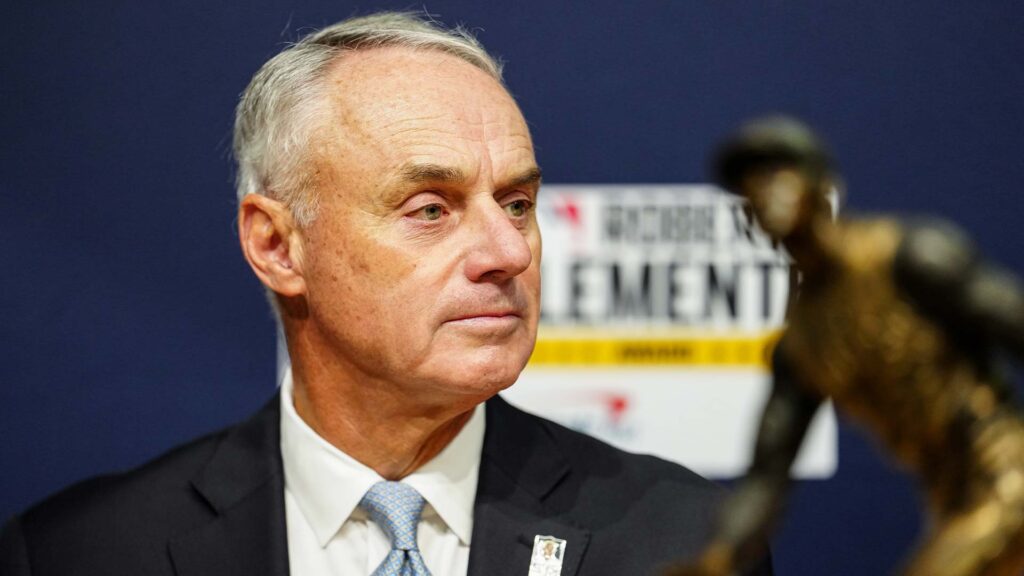
Baseball Commissioner Rob Manfred worries the owners’ salary cap proposal could lead to a work stoppage like the one that caused the cancellation of the 1994 World Series, and says the plan is necessary because management concluded the luxury tax system in place since 2003 no longer works.
Owners last week made their first cap proposal since 1994, when a 7 1/2-month strike caused the cancellation of the World Series for the first time in 90 years. Manfred was a junior attorney on the owners’ negotiating team in those negotiations.
Players have vowed to fight a cap for as long as it takes. Asked if he worries that the events of 1994-95 will be repeated, Manfred replied: “Of course I do.”
“We’re open to all the ideas people have, but we need a realistic framework that addresses the fans’ concerns about competitive balance, and you just can’t ignore that financial penalties haven’t gotten it done for us,” he said Wednesday at a news conference during an owners meeting.
Baseball owners and players started the current luxury tax system for the 2003 season and in subsequent agreements have increased tax rates and added surcharges.
“We have tried hard through several rounds of negotiations to use a competitive balance tax to address competition issues, and sometimes you have to admit that you failed,” Manfred said.
More teams have been willing to exceed the tax thresholds in recent years, with a record nine teams paying the penalty in both 2024 and 2025, with the Dodgers hit with a bill of $169.4 million. Total taxes increased from $78.5 million in 2022 to $222.8 million the following year, $311.3 million in 2024 and $402.6 million last year.
“We never thought of CBT as a revenue-generating entity,” Manfred said. “And when you see more and more tax being paid, you realize it’s not the kind of speed bump that would help the issue of competitive balance.”
Baseball’s five-year collective bargaining agreement, which was agreed to in March 2022 after a 99-day lockout, expires on December 1. Management is expected to institute a lockout, which would bring free-agent signings and trades to a halt.
Manfred would not say publicly whether management believed a stoppage would be worth the price to achieve a cap.
“I’m not going to speculate about work stoppages,” he said. “I think the proposal we’ve put forward is the basis for constructive dialogue and back-and-forth with the MLBPA on how we can address our fans’ biggest concern, which is a lack of competitive balance in the game.”
MLB would cap spending in 2027 at $245.3 million using figures for luxury tax payments that include $20.1 million for benefits and the pre-arbitration bonus pool. It would also establish a $171.2 million salary cap, forcing some teams to spend more. The Dodgers had an opening day payroll of $415.2 million this year, while the lowest payroll was Miami at $81.8 million.
“The players are smart people,” Manfred said. “I think they understand that wages are a significant advantage for certain clubs and that clubs with high wages win more than clubs with low wages.”
No small-market team has won the World Series since the 2015 Kansas City Royals.
“Teams that go through periods, especially extended periods, of not being competitive not only have lower revenues, but they are slower to recover once they become competitive,” Manfred said.
MLB proposed a 50-50 split with defined-earning players and an escrow system where portions of the salaries would be withheld for repayment to the league in the event that players’ share in a year exceeds 50%.
“If their proposal would have been in place in 2026 with current amateur enrollment figures, the players would have lost more than half a billion dollars,” union president Bruce Meyer said in a statement.
Manfred said MLB has not yet made a proposal for players to sign initial professional contracts.
Players asked for expanded rights to free agency and salary arbitration, increased luxury tax thresholds and nearly doubling the major league minimum and increased revenue sharing.
Baseball has had nine work stoppages since 1972, the most recent being a 99-day lockout that slightly delayed the 2022 season.
The NFL has had a national game since 1994, the NBA since 1984-85 and the NHL since 2005-06.
Enlargement
MLB will not consider a possible two-team addition until there is a new CBA. Among those expressing interest have been groups from Charlotte, North Carolina; Montreal; Nashville, Tennessee; Portland, Ore.; Sacramento, California; and Salt Lake City.
“We’ve made it clear to all the cities that have expressed interest in saying a post-labor topic,” Manfred said.
BEER
Manfred hopes the union will agree to a decision on whether the major leagues will go to the 2028 Los Angeles Olympics before reaching a labor agreement.
“It is my impression that they are thinking of a separate track,” he said. “I hope so, because we can’t wait until we have a collective bargaining agreement to commit to it.”
Union head Bruce Meyer says a walkout that cancels regular-season games could disrupt Olympic plans.
Local broadcast media
MLB’s proposal would pool and evenly distribute local broadcast revenue, tied to agreement on a salary cap. MLB plans to negotiate new national broadcast contracts for the 2029 season.
“There’s definitely going to be more internationals. That’s our number one priority in terms of reach going forward,” Manfred said. “How the inventory after these international matches is monetized is going to depend on the market.”
With the decline of regional sports networks, MLB is producing and distributing local broadcasts from 14 teams this season. Local media revenue is “significantly down,” according to Manfred.
“The form of revenue sharing in the proposal was certainly influenced by developments in the media market and where we think we need to be to get the maximum revenue out of the media environment as it exists today,” Manfred said. “You need more control over rights.”
Padres sale
Owners have not yet approved the proposed sale of the San Diego Padres from the Seidler family to an investor group led by Kwanza Jones and José E. Feliciano. The deal was announced on May 2. The sale has an enterprise value of a baseball-record $3.9 billion, with some investors remaining in the fold.
“Not ready for a vote today,” Manfred said. “It will probably be sometime this summer.”
Ray’s ballpark
Manfred is pleased with the Rays’ efforts to get government approvals for a new ballpark in Tampa, near the spring training stadium of the New York Yankees.
“They have to find the final documents. I understand that they are on a timeline of mid-July,” he said. “We hope they get over the next hurdle.”
Report from the Associated Press.