
Envoy says veto powers should either be abolished or their use ‘severely limited’
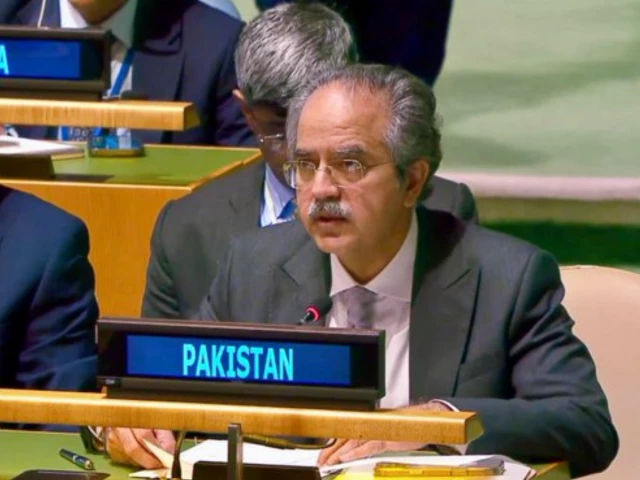
Pakistan’s Permanent Representative to the UN, Ambassador Asim Iftikhar Ahmad speaks at the UN. PHOTO: X
Pakistan on Wednesday called for the abolition or strict limitation of the veto power in the United Nations Security Council (UNSC), while strongly opposing any expansion of permanent membership, including the creation of new veto-wielding states.
Speaking at a resumed session of the Intergovernmental Negotiations (IGN) on Security Council reform, Pakistan’s Permanent Representative to the United Nations, Ambassador Asim Iftikhar Ahmad, said the current structure often leads to paralysis in global decision-making.
Statement by Ambassador Asim Iftikhar Ahmad,
Permanent Representative of Pakistan to the United Nations,
During the 3rd IGN Cluster Meeting “Question of Veto”
(April 14, 2026)
*******co-chairs,
Pakistan endorses the statement of the distinguished Permanent… pic.twitter.com/eQ9VJQ8I05
— Permanent Mission of Pakistan to the United Nations (@PakistanUN_NY) 15 April 2026
He said Pakistan “firmly believed that the paralysis that we often see in the Security Council leading to inaction on crucial issues related to international peace and security stems from the permanent members’ misuse or abuse of the veto.”
Ambassador Iftikhar reaffirmed Pakistan’s position that “any expansion of the veto power or addition of new individual permanent members is strongly opposed as multiple vetoes would only exacerbate the problem.”
He described the veto system as “anachronistic today” and said Pakistan’s position remains clear and consistent that it should either be abolished or its use “severely limited.”
Read more: The Prime Minister will today begin official visits to Saudi Arabia, Qatar and Turkey amid the Middle East crisis
The ambassador also argued that expanding the number of elected, non-permanent members could help restore balance in the Security Council. “Increasing the number of elected members will tip the balance away from the permanent members,” the envoy said.
He added that when a veto blocked action supported by a broad majority, it becomes “more isolated and harder to justify, increasing accountability and reputational costs.”
The Pakistani envoy further supported greater transparency in veto use and strengthening of mechanisms that enable the UN General Assembly to review and debate such resolutions.
The envoy also emphasized that Security Council reform must be comprehensive and cover all key issues together, including membership categories, regional representation and working methods. He cautioned against treating veto reform in isolation, repeating, “If we want reform for all, there should be privilege for no one.”
Full-scale negotiations to reform the Security Council began in the General Assembly in February 2009 on five key areas – the categories of membership, the issue of the veto, regional representation, the size of an enlarged Security Council and the Council’s working methods and its relationship with the General Assembly.
Progress towards restructuring the Security Council remains blocked as the G-4 countries – India, Brazil, Germany and Japan – continue to push for permanent seats on the council, while the Italy/Pakistan-led Uniting for Consensus (UfC) group opposes any additional permanent members. arguing that it would create “new centers of privilege”.
As a compromise, the UfC has proposed a new category of members – not permanent members – with a longer duration of the election period and the possibility of being re-elected.
The Security Council currently consists of five permanent members – Britain, China, France, Russia and the United States – and 10 non-permanent members elected for two-year terms.
The IGN Framework is geared towards restructuring the Council to make it more representative, effective and accountable.


