
Says Karachi attack proved Afghan soil continued to be used for terrorism inside Pakistan
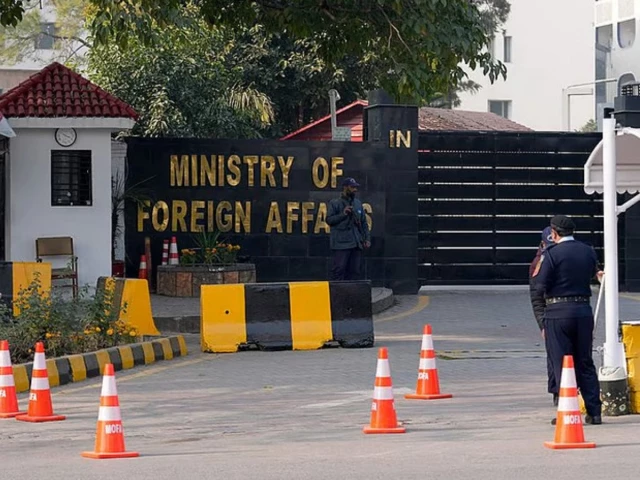
Police officers stand guard at the main entrance of the Ministry of Foreign Affairs in Islamabad. Photo: File
Ministry of Foreign Affairs (MoFA) spokesperson Tahir Andrabi said on Monday that the Afghan chargé d’affaires was summoned and issued a strong demarche over the terrorist attack on the Rangers camp in Karachi.
On Saturday, security forces foiled a terrorist attack in Karachi in which three Pakistan Rangers (Sindh) personnel embraced martyrdom and four others were injured. According to the military’s media wing, the attack was launched by “Khwarij associated Indian agent, Jamaat-ul-AhrarAfter an explosion at the main gate of the Rangers camp, the assailants tried to breach the perimeter security but were pushed back by personnel killing three Kharjis and captured one, identified as an Afghan national, in an injured condition.
According to Andrabi, “the Afghan chargé d’affaires was summoned to the MoFA last night and a strong demarche was issued regarding the terrorist attack in Karachi. A similar demarche was conveyed by the Ambassador of Pakistan, Mr. Ubaid-ur-Rehman Nizamani, to the Afghan Ministry of Foreign Affairs.”
He said the demarche “was issued in light of the fact that Afghan nationals, including one who was apprehended alive, participated in this attack, which once again proves that Afghan soil and Afghan nationals continue to be used to orchestrate terrorist attacks inside Pakistan.”
In May, Pakistan had summoned the Afghan chargé d’affaires and issued a “strong demarche” over a vehicle-borne IED attack carried out by Fitna al-Khawarij on a police post in Khyber-Pakhtunkhwa’s Bannu district, which martyred 15 police officers.
Terrorists had rammed an explosives-laden vehicle into the Fateh Khel police checkpost, martyring 15 personnel and injuring three others. The attack triggered a massive explosion that destroyed the checkpoint and left several people trapped under the debris.
The demarche “conveyed that a detailed investigation of the incident along with evidence and technical intelligence indicated that the attack was masterminded by terrorists residing in Afghanistan,” the MoFA had said.
It added: “Reiterating Pakistan’s grave concern over the continued use of Afghan soil for terrorist attacks against Pakistan, the impression on the Afghan side was that Pakistan reserves the right to respond decisively against the perpetrators of this barbaric act.”
Read: Undocumented Afghans risk immediate arrest
Following the terrorist attack on the Karachi Rangers camp, as well as those in Khyber-Pakhtunkhwa and Balochistan, Information Minister Attaullah Tarar stated that Pakistani security forces were continuing Operation Ghazab Lil Haq.
The operation, launched around the end of February, followed renewed clashes along the Pakistan-Afghanistan border, with Afghan Taliban forces firing at several locations, prompting swift military retaliation from Islamabad. Clashes intensified after Afghanistan launched a border offensive in response to Pakistani airstrikes targeting terrorist positions.
Islamabad accuses the Afghan Taliban of harboring militants who launch attacks in Pakistan, although Kabul denies this, calling the militancy Islamabad’s domestic problem.
The two sides agreed to a week-long ceasefire on the eve of Eidul Fitr on March 18 following requests from Türkiye, Saudi Arabia and Qatar. In April, Pakistan made three core demands to the Afghan Taliban during peace talks in Urumqi, China, including Kabul formally declaring the Tehreek-e-Taliban Pakistan (TTP) a terrorist organization, dismantling its infrastructure and providing verifiable evidence of the action.
The demands form the basis of Pakistan’s negotiating position, which sources say has hardened amid ongoing security concerns.


