
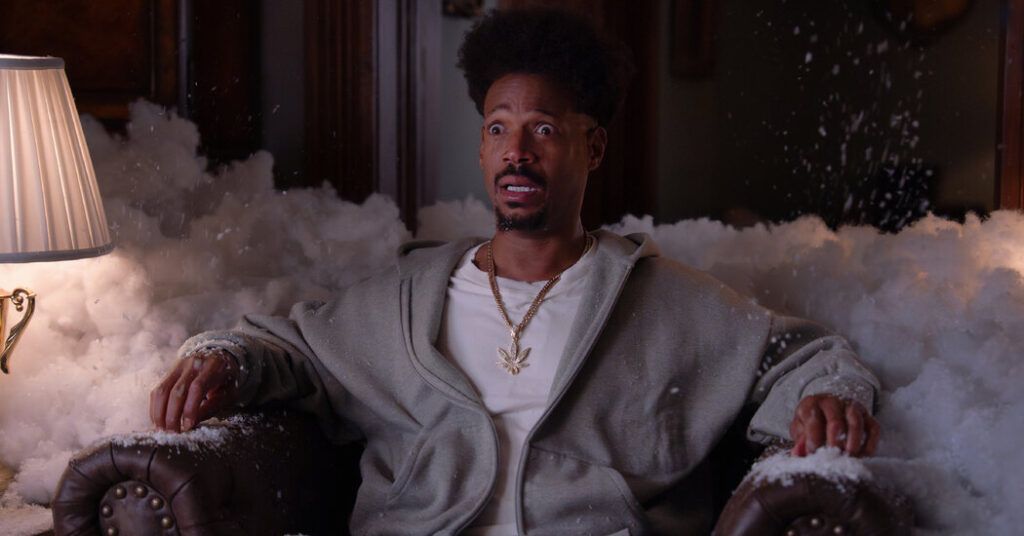
About a decade ago, Hollywood decided that crude, politically incorrect humor was a commercial and cultural duty. The #MeToo and #BlackLivesMatter movements took off, and studio executives (largely liberal and intensely risk-averse) stopped supporting crime comedies like “Ted” and “Tropic Thunder.” Why invite a Twitter firestorm?
That period of timidity — some would call it “wokeism” — may have ended this weekend.
“The culture is ready for a level of outrageousness that has been missing,” Josh Goldstine, president of global marketing and distribution at Paramount Pictures, said on Sunday. “You have to have the will, the guts, to just go for it.”
“Scary Movie,” marketed by Paramount with the slogans “cancellation of culture’s cancellation” and “lines will be crossed,” grossed an estimated $55 million at North American theaters over the weekend, according to Comscore, a data service. The total, easily enough for No. 1, was about 22 percent more than box office analysts had predicted before the film’s release based on advance ticket sales and surveys that track moviegoer interest.
The opening for “Scary Movie” was the biggest for an R-rated comedy in 12 years. In 2014, the vulgar “22 Jump Street” took in $57 million in its first three days, or about $80 million after adjusting for inflation.
“Scary Movie,” a reboot of the 2000s parody series created by the Wayans family, cost an estimated $30 million to make, excluding marketing. It was produced by Miramax, which is co-owned by Paramount and the Qatari company beIN Media. The film was distributed by Paramount, which was taken over by David Ellison last year.
Overseas, “Scary Movie” collected another $50.5 million for a global opening of $105.5 million.
“A safe comedy wouldn’t be a mess,” said Jonathan Glickman, CEO of Miramax. Speaking of Mr. Ellison and his team added Mr. Glickman: “We and the new management at Paramount really felt that ‘Scary Movie’ and Wayans could be the gateway to bringing back R-rated comedy — brand name movies, but also R-rated originals.”
For the weekend in North America, “Masters of the Universe” took second place. The film, which cost Amazon MGM Studios more than $200 million to make and market, debuted to about $29 million in box office sales, which was about 17 percent less than analysts had predicted. “Masters of the Universe” was an attempt to turn Mattel’s line of He-Man toys from the 1980s into a modern movie franchise.
Nostalgia may not have worked in He-Man’s favor, but it almost certainly increased interest in “Scary Movie.” According to exit polls conducted by PostTrak, a Hollywood research service, about 88 percent of “Scary Movie” ticket buyers in the United States and Canada described themselves as fans of the franchise, which has been dormant since 2013.
“A lot of people grew up with the earlier movies,” said Mr. Glickman and noted that 72 percent of “Scary Movie” ticket buyers this weekend were under the age of 34.
Keenen Ivory Wayans directed the first “Scary Movie” in 2000 from a script written by Shawn and Marlon Wayans (and four others). By 2006, the original film and three sequels had grossed an astonishing $818 million worldwide.
An attempt to reboot the series in 2013 went badly. Stars like Anna Faris and Regina Hall had moved on. More crucially, Wayans was no longer involved: Bob and Harvey Weinstein, who controlled the rights, had brazenly cut Wayans out amid a dispute over compensation. “Scary Movie 5” grossed just $32 million in North America over its entire run.
The new “Scary Movie” also benefited from pent-up demand for a comedy (R-rated or otherwise) with black stars, analysts said. Eleven members of the Wayans family appear in the film to varying degrees. Mrs. Hall and Teyana Taylor have big roles. Kenan Thompson, Anthony Anderson, Shaquille O’Neal and popular YouTube comedian Kai Cenat have cameos.
As with the previous films, much of the humor in “Scary Movie” comes from mocking horror films. Horror is currently an astonishingly hot genre at the box office, as evidenced by recent runaway hits like “Backrooms” and “Obsession.”
Many moviegoers also seemed ready to laugh at taboo jokes about race, gender, sexuality and mental illness. Spoiler alert: The “woke” character in “Scary Movie” dies a humiliating death.
“We wanted to tap into the larger zeitgeist where people are in the form of laughter,” said Mr. Goldstein. “If we can all laugh together – laugh at each other, laugh at ourselves – something culturally contagious and exciting can happen.”
Critics were not there. Reviews were 26 percent positive, according to Rotten Tomatoes.
Brandon Yu, reviewing “Scary Movie” for The New York Times, wrote that the film, directed by Michael Tiddes, relied on “throwback humor” that was “lazy and boring half a generation ago.” He added: “The already low franchise has taken an appalling turn for the worse.”
Still, the weekend was a triumph for Miramax and Mr. Glickman, who took over the boutique film company in 2024. Miramax had been working on a “Scary Movie” reboot that excluded Wayans, but Mr. Glickman fought to scrap that project and bring the brothers back.
“I knew they were going to be allowed to go to a very nerve-wracking place at a time when a lot of people are still worried about how edgy theatrical comedy can be,” Mr. Glickman.
Miramax will likely move forward with more “Scary Movie” sequels. Mr. Glickman and his team are also working on a sequel to the 2003 R-rated comedy “Bad Santa.” “Hopefully these guys have reopened the R-rated floodgates,” Mr. Glickman said. Glickman.


