
StarkWare is restructuring into two business units and cutting staff as it moves from scaling Ethereum to building its own revenue-generating products — a shift forced by a more than 99% collapse in revenue on its flagship Starknet network.
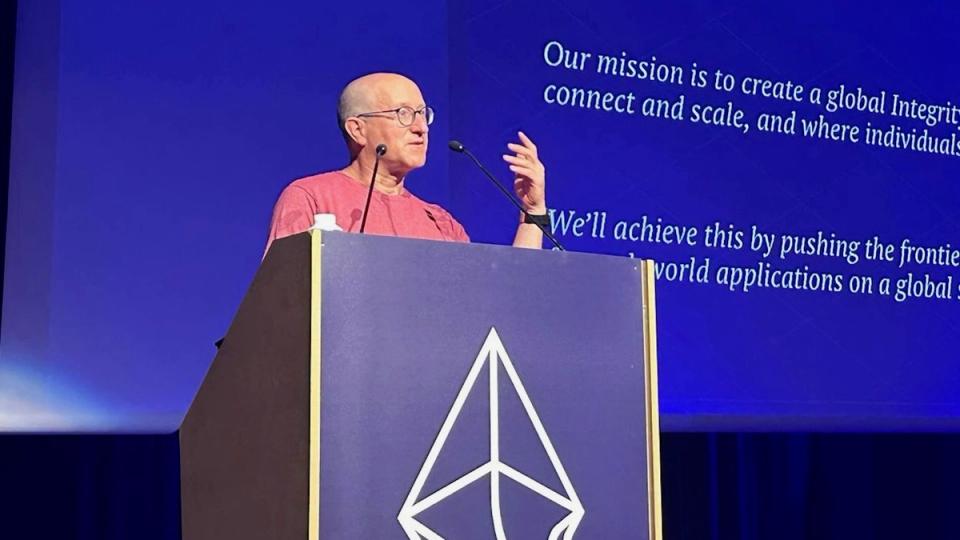
The changes were outlined during a company-wide town hall hosted by CEO Eli Ben-Sasson, where he told employees that StarkWare would restructure into two independent entities and focus on building revenue-generating products in-house. A transcript of the staff address was reviewed by CoinDesk.
The Starknet chain’s revenue, which peaked near $6 million in a single month in late 2023, was around $48,000 through the first half of April 2026, according to DefiLlama data. The decline is partly industry-wide, with Starknet’s competitors equally affected, as Ethereum’s EIP-4844 upgrade in March 2024 reduced Layer 2 fee revenues across the board.
However, Total Value Locked (TVL) remains above $200 million.
Ben-Sasson told employees that the company now needs to “take our technological superiority… and convert it into meaningful revenue, meaningful use,” signaling a shift away from a pure infrastructure focus toward building products that can directly drive demand.
He added that StarkWare would prioritize building “things that can’t be done by any other team, in any other way,” focusing resources on products with “huge potential revenue” over broad experimentation.
“I started in this field in 2013, almost 13 years ago, and I’ve seen quite a few winters,” Ben-Sasson said at City Hall. “I think what marks this winter is that there is a very clear vacuum in leadership across the blockchain, and it’s even affecting things like Bitcoin and Ethereum.”
The company will create a new revenue-focused application unit led by researcher Avihu Levy.
Levy’s promotion comes days after he published a paper describing Quantum Safe Bitcoin, or QSB, a method to make bitcoin transactions resistant to quantum attacks without requiring changes to the protocol.
The approach replaces traditional signature schemes with hash-based proofs, but comes with significant tradeoffs that require extensive off-chain computations and cost an estimated $75 to $200 per token. transaction, versus about $0.33 for a standard bitcoin payment.
QSB offers an alternative to BIP-360, a long-awaited proposal to add quantum resistance to Bitcoin at the protocol level that was merged with Bitcoin’s Improvement Proposal Repository in February but could take years to activate.
Ben-Sasson did not mention Bitcoin or quantum security as the application unit’s goals, saying only that StarkWare would focus on products “that cannot be done by any of our competitors” and build with “minimal reliance on external L1s or external application teams.”
More details, he told staff, would come next week.
A spokesman for StarkWare declined a request for comment.


