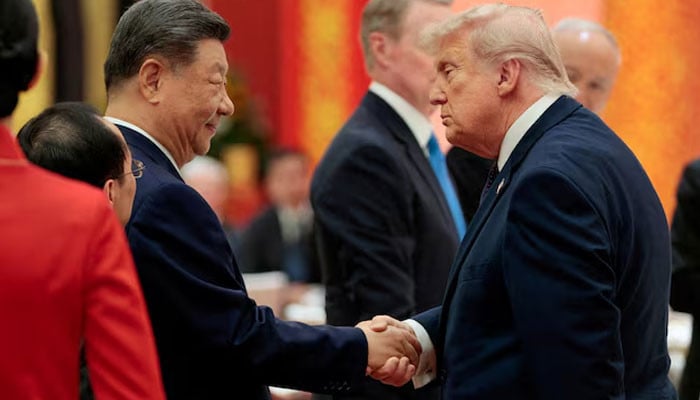
- IMF welcomes constructive talks between Donald Trump and Xi Jinping.
- The Fund reiterates support for dialogue instead of unilateral trade measures.
- The IMF warns of the conflict in the Middle East damaging the global economic outlook.
WASHINGTON: The International Monetary Fund said on Thursday it welcomed initial positive dialogue between US President Donald Trump and Chinese President Xi Jinping, adding that it was good for the world to reduce tensions and uncertainty between the world’s two biggest economies.
“It is obviously very important that the world’s two largest economies engage at the highest level,” IMF spokeswoman Julie Kozack told a news briefing when asked about the initial results of the Trump-Xi summit in Beijing.
“We certainly welcome the fact that there is a constructive dialogue between the two countries. Anything that’s going to help reduce trade tensions and reduce uncertainty is good for both of these major economies, and of course good for the global economy,” Kozack added.
The IMF has long urged the US and China to resolve their trade differences through dialogue, not unilateral measures.
In Beijing on Thursday, Xi launched the two-day summit with a warning to Trump that mishandling the countries’ differences over Taiwan could push US-China relations to a “very dangerous place”.
But a year after Trump’s steep tariffs on Chinese goods and Xi’s retaliation nearly collapsed all US-China trade, the two leaders’ discussions on trade and investment were more positive.
Trump said in a Fox News Channel interview with Sean Hannity that China agreed to order 200 Boeing BA.N jetliners, while US Treasury Secretary Scott Bessent told CNBC that deals for US energy and agricultural goods were also being discussed, along with the creation of bilateral trade and investment bodies for non-strategic sectors.
Economic pressure
Kozack said that due to pressure from the war in the Middle East and Iran’s closure of the Strait of Hormuz, which has kept crude oil prices above $100 a barrel. barrel, the global economy is clearly moving into the middle of the three economic scenarios outlined by the IMF in its World Economic Outlook in April.
The IMF’s middle “adverse scenario” would see global real GDP growth fall to 2.5% this year, compared to 3.1% in the more benign “reference forecast”, which assumes a quick end to the conflict, from 3.4% growth in 2025.
The negative scenario assumes $100 per barrel of oil for the whole year, but also a tightening of financial conditions and rising inflation expectations.
Kozack said that while higher energy prices have pushed up expectations of near-term price increases, the IMF sees medium-term inflation expectations as remaining well-entrenched. And financial conditions in the global economy remain “accommodating,” she said.
Help calls
IMF Managing Director Kristalina Georgieva will discuss global economic issues with finance ministers and central bank governors from Group of Seven industrial democracies next Monday and Tuesday in Paris, Kozack said. IMF First Deputy Managing Director Dan Katz is attending a G20 meeting in Miami of deputy finance ministers and central bank governors on Thursday and Friday this week, she added.
The IMF continues to discuss possible financial assistance for member countries struggling with higher energy and commodity costs due to the conflict in the Middle East, Kozack said.
But she gave no details on specific countries, nor did she comment on a Reuters report that Iraq has sought financial aid.
Georgieva said during the IMF and World Bank spring meetings in April that at least 12 countries were expected to need a total of $20-50 billion in aid from the two institutions, which are consulting on how best to help member states.
Kozack declined to provide any updates to those numbers.
“Right now what we’re seeing is that many countries are actually asking us for support in the political area,” she added. “They ask us for policy advice. How can they best respond to the shock given the circumstances of the individual countries?”
The fund said in April that member countries should avoid broad fuel subsidy subsidies that would drain scarce fiscal resources and boost oil demand at a time of tight supplies, further pushing up prices.