With a smartphone strapped to her head, Indian housewife Nagireddy Sriramyachandra films herself slicing mangoes to train AI-powered robots to take on household jobs in the future.
Her mundane footage earns just over two dollars for an hour of video and is invaluable to global technology companies teaching machines how to move like humans in the real world.
The 25-year-old is one of a growing army of thousands of AI systems trainers in the world’s most populous country.
“Who else will pay you ₹250 an hour just to do housework?” Sriramyachandra said from his kitchen in Chennai, in the southern Indian state of Tamil Nadu.
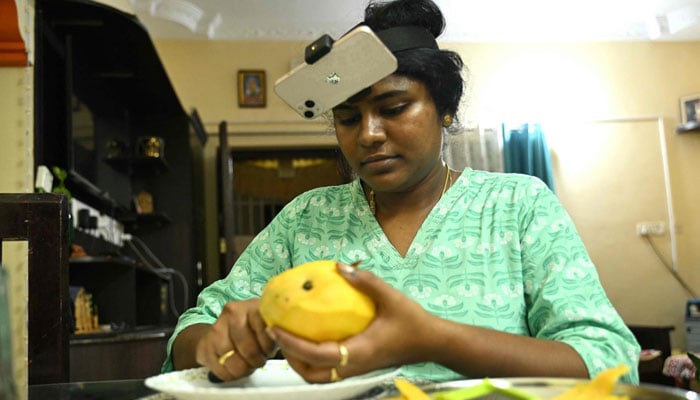
“I might get a robot myself in the future,” she added.
Artificial intelligence chatbots and image generators are crunching reams of digital data, but building systems to navigate real-world environments is more challenging.
Developers believe that feeding first-person footage, called “egocentric data,” into specialized AI models will help robots copy humans.
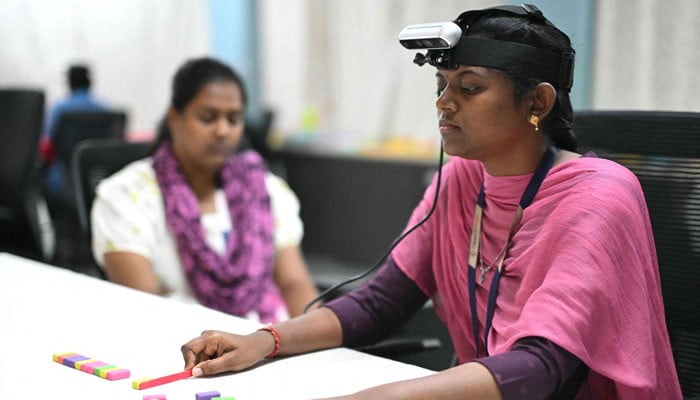
Some AI trainers work at home, others in factories or specialized studios – using video glasses, head-mounted cameras and motion sensors.
“It says ‘hands not detected’ when I’m not recording properly,” said Sriramyachandra, who sends footage via a special app to AI data firm Objectways.
The firm, which has offices in India and the US, lists Fortune 500 multinationals as clients. It works with Amazon SageMaker, a platform for machine learning models.
‘Better Things’
The market for humanoid robots is booming, and investment bank Morgan Stanley predicts there could be over a billion in use by 2050, mostly for industrial and commercial purposes.
“Folding clothes, making coffee… making a very specific thing, making sandwiches,” said Objectway executive Ravi Shankar, listing videos requested by customers.
“Some jobs are supposed to be taken over so people can go and do better things.”
In India, the emerging field of spatial AI is bringing new employment—for now.
The 50-year-old CEO is based in the US but hires workers from Tamil Nadu, where he grew up, one of India’s international technology hubs.
At a textile factory in Karur, busy with workers putting labels on caps and ironing fabric bags, AFP saw eight people wearing head cameras and smart glasses provided by Objectways.
India has positioned itself as a global intermediary for creating, processing and annotating AI data.
“These data collection services are likely to increase,” said digital labor expert Aditi Surie, of the Indian Institute for Human Settlements in Bengaluru.
Informal workers
India is aggressively developing its artificial intelligence industry, but its leaders are aware that automation, along with the technology’s much-hyped benefits, poses risks.
Government think tank Niti Aayog said most discussions around artificial intelligence and labor “focus on white-collar workers and predict an almost certain loss of jobs in the segment” without immediate action.
“Little attention, if any, has been paid to how AI can serve India’s 490 million informal workers, the very people who form the backbone of our economy,” said a report released ahead of a global AI summit in India this year.
The think tank has examined how the technology could help or hurt dozens of professions – from shoemakers to sewer cleaners, farmers to tea sellers.
For the past decade, 55-year-old Ponni has been sitting on a roadside in Bengaluru, the city known as India’s Silicon Valley, making flower garlands.
She too has been paid to have a phone strapped to her forehead.
“The next generation… who may have to do work similar to mine – they will face a problem,” Ponni said.
Always wearing a camera
In an Objectways studio, AI system trainers film themselves performing household tasks in mock, fully furnished apartment rooms.
After several thousand hours of recording, the wallpaper is changed to give customers variety.
“Today I’m sitting here, tomorrow I’m standing there,” said engineering graduate Rani N., 21, on a break from filming herself, again folding a towel.
Each video lasts about four minutes, and she records about 90 a day – in almost every imaginable place on the bed.
She says the job is “acceptable” but feels she always has a camera on her.
In other rooms, colleagues arranged pencil sharpeners, water bottles and crayons in patterns and shot with depth-sensing cameras.
Qanat Consulting Services in Andhra Pradesh, an Objectway subcontractor, supplies about a dozen major data companies with recordings.
Some of its 2,000 contributors perform tasks with motion sensor bands on their “wrist, hands and legs,” CEO Thaslim Pattan said.
Manish Agarwal of Bengaluru-based Humyn Labs, not related to Objectways, records conversations as well as videos.
Contributors discuss assigned topics—ranging from politics to entertainment—for clients looking to address speech patterns.
Agarwal denies that robots will steal jobs and believes that networks of humans and robots “will work together” one day, he said.
“A welder in India could control a welding robot in Prague,” he said.