
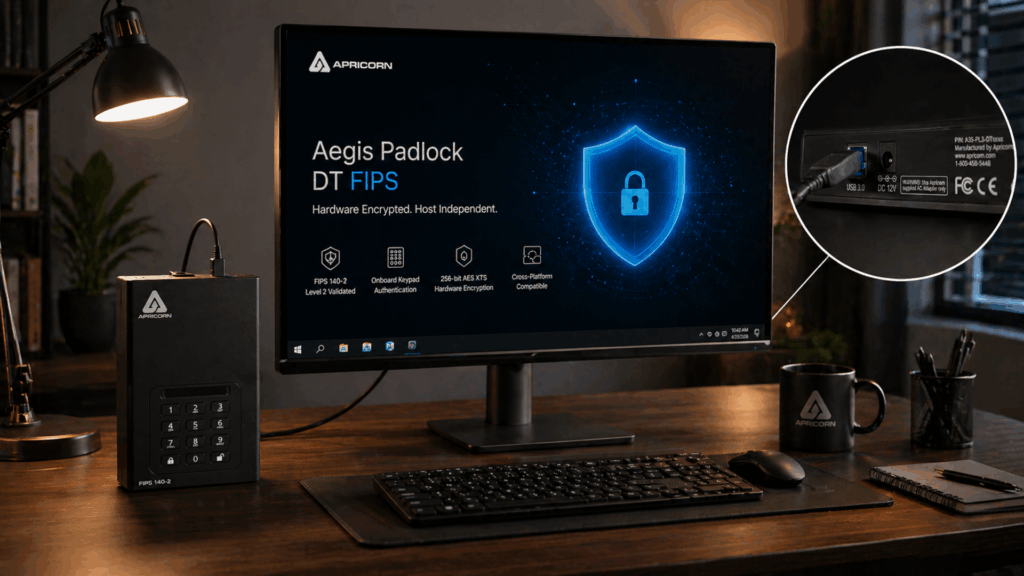
- Aegis padlock DT FIPS processes PIN codes on the device, not on the connected computer
- This drive works where software-based encryption cannot, including embedded systems
- Epoxy coating and locked firmware prevent physical tampering and BadUSB attacks on the padlock DT FIPS
Most companies assume that encrypting their sensitive data is enough, but encryption only matters if the keys and authentication methods remain out of reach of attackers.
Software-based encryption tools leave these secrets exposed on the host computer, where keyloggers, screen scrapers, and remote access Trojans can easily capture them.
To help address this, Apricorn has expanded its Aegis Padlock DT FIPS line with a new 32TB model that removes the host system from the security equation entirely.
The article continues below
Encryption that never touches your computer
“Offline, encrypted storage plays a critical role in broader data protection and resilience strategies,” said Kurt Markley, CEO of Apricorn.
The DT FIPS padlock performs all authentication directly on the device using a built-in keypad, meaning no PIN code ever touches the connected computer.
Users enter their code into the secure drive itself, and it handles all encryption and decryption internally through Apricorn’s proprietary AegisWare firmware.
It eliminates exposure to keyloggers, memory scrapers and other endpoint-based attacks that plague software-based solutions.
This external hard drive secures data in real-time as information is written, and both the PINs and stored data remain encrypted while the drive is idle.
The firmware is locked down to prevent any modifications, making the drive immune to malware attacks such as BadUSB, which can reprogram regular USB drives.
What the device delivers for its price tag
The 32TB model costs a whopping $1,999.00, joining 12 other capacities starting at the 2TB model, which costs $289.00.
This drive allows organizations to consolidate massive data sets on a single device that can be completely isolated from network-based threats.
All internal components are protected from physical tampering with a layer of hardened epoxy.
It carries FIPS 140-2 Level 2 validation, certification number 4528 from NIST, confirming that it meets strict government security standards.
It also offers hardware-based 256-bit AES XTS encryption, software-free setup and operation, and cross-platform compatibility with Windows, Linux, Mac, Android, and Chrome.
This drive works where software-based encryption cannot, including embedded systems, diagnostic machinery, and any powered USB device with file storage.
Padlock DT FIPS data transfer runs over a USB 3.2 Gen 1 interface, which delivers up to 5 Gbps and remains backward compatible with USB 3.0, 2.0 and 1.1.
The drive includes an 8MB buffer and an average seek time of 12 milliseconds, and can withstand shocks up to 70G while running and 250G when powered off.
There are some drawbacks
While the concept of removing the host computer from the security chain is technically sound, Apricorn’s solution addresses only one piece of a much larger puzzle.
A drive that remains offline is safe from remote attackers, but the moment someone connects it to a computer to read or write data, the integrity of the system becomes relevant again.
The keypad prevents PIN theft, but it doesn’t prevent a hacker with physical access from simply taking the drive.
Organizations that purchase this device still need to manage who has access to it, where it is stored, and which computers it connects to.
The hardware is secure, but the people who operate it remain the weakest link.
Follow TechRadar on Google News and add us as a preferred source to get our expert news, reviews and opinions in your feeds.


