
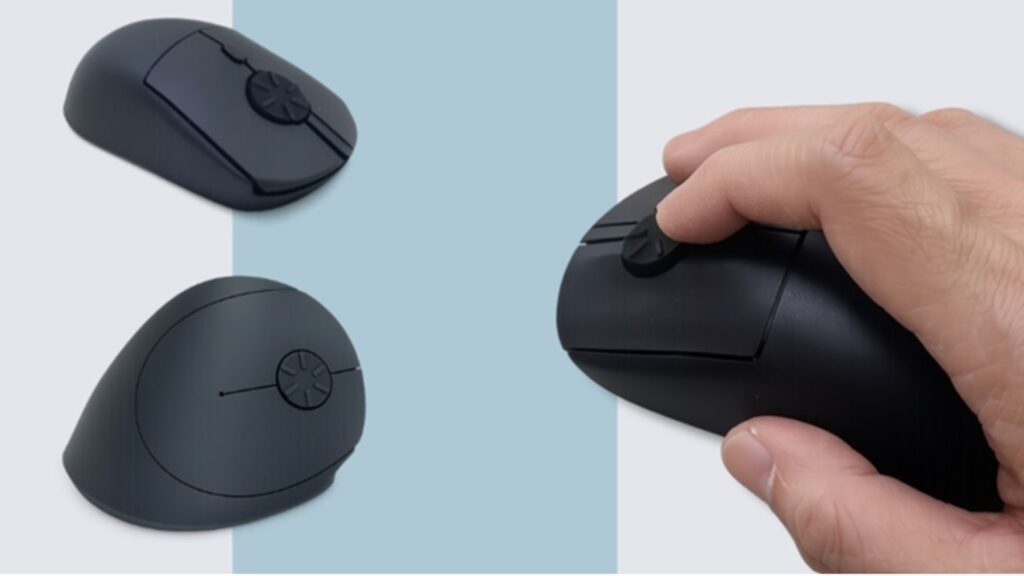
- The Rotary Mouse replaces the traditional mouse wheel with continuous movement
- The device claims faster navigation through documents and spreadsheets
- Users report smoother timeline scrubbing in editing software
The scroll wheel on a mouse has barely changed in three decades, and most people have stopped questioning whether it still works well.
But a device called the Rotary Mouse now claims to let users move through documents, spreadsheets and timelines at speeds that regular swiping simply can’t match.
The product’s pitch centers on a single mechanical swap that replaces the familiar up-and-down wheel movement with a continuous dial that the manufacturer says feels closer to turning a knob than clicking a switch.

Another move, another claim
According to the campaign, the rotary input allows users to scroll or scrub through content up to 2.5 times faster than a standard mouse wheel, while reducing the repetitive strain associated with constant flicking.
Instead of short up-and-down movements, users turn the wheel like a small knob, controlling speed and direction through pressure and motion.
The device still supports conventional vertical scrolling, meaning users can switch between familiar inputs and rotary controls without changing devices or habits.
It measures 119mm by 64mm by 40mm in a matte black ergonomic shell, weighs just 59g without battery and supports 2.4GHz wireless connectivity.
The Rotary Mouse also features an optical sensor with switchable 800, 1200 and 1600 DPI sensitivity settings, allowing users to fine-tune pointer speed and precision.
Its left and right buttons are muted through a center button built into the rotary wheel itself.
The device comes with a AAA alkaline battery and a wireless USB receiver and works across Windows, Linux, Mac OS and Android.
Some testers describe the Rotary Mouse’s movement as more fluid and easier to control, especially when trying to stop at precise points on a timeline or page.
The design also introduces tactile feedback through clicks during rotation, which is intended to help users maintain control during faster movement.
Early use cases and mixed reactions
Early adopters have tested the device in video editing software, where timeline scrubbing is a frequent task that requires fine control and repetitive motion.
In programs like Adobe Premiere Pro and DaVinci Resolve, the Rotary Mouse is used as a scrubbing tool, where rotating the dial allows users to move through video timelines more smoothly than repeated scrolling
In simulation racing setups, the same rotary input can be mapped directly to steering control, making the dial a compact alternative to traditional wheel or keyboard-based controls.
This makes it useful in games like Euro Truck Simulator 2, Assetto Corsa and BeamNG.drive where gradual steering inputs are required and can be replicated through controlled rotation.
The concept has also gained attention online, with thousands of upvotes across PC enthusiast communities discussing alternative input devices and ergonomic design ideas.
The creator, Melvin Wong, an electronics engineer with extensive experience in hardware development, says the idea came from reducing finger strain during long computer sessions.
Prototypes were built using 3D printing techniques before developing into early production units.
He claims that continuous rotation reduced repetitive loads while unexpectedly improving navigation speed across large digital workspaces during testing phases.
Independent verification of the claimed speed improvements remains limited, however, and real-world performance likely depends on user behavior and application type.
The Rotary Mouse is currently crowdfunding on Kickstarter, where it has raised $3,654 against a $14,794 goal from 61 backers, with 18 days left before the campaign ends.
The team also says it has already sold more than 30 pre-production Founder’s Edition units and aims to start shipping the final product in December 2026.
Disclaimer: We do not recommend or endorse any crowdfunding project. All crowdfunding campaigns have inherent risks, including the possibility of delays, changes or non-delivery of products. Potential backers should carefully assess the details and proceed at their own discretion.
Follow TechRadar on Google News and add us as a preferred source to get our expert news, reviews and opinions in your feeds. Be sure to click the Follow button!
And of course you can too follow TechRadar on TikTok for news, reviews, video unboxings, and get regular updates from us on WhatsApp also.


