
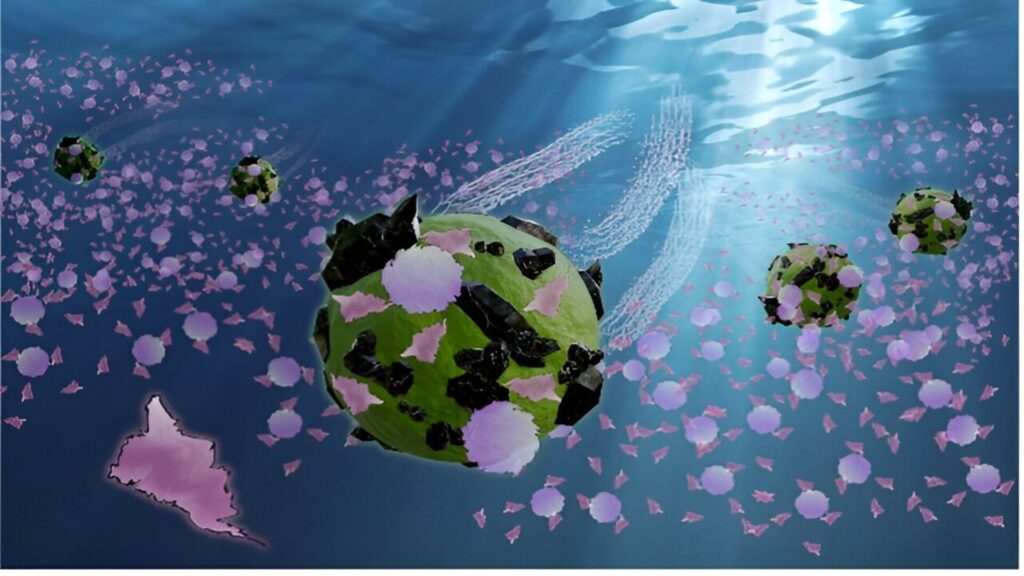
- Small robots actively hunt nanoplastics instead of waiting for contact
- Electrostatic attraction lets the nanobots grip plastic-like charged surfaces
- Magnetic control enables precise movement without fuel or light
There is a lot of plastic waste in the world, which is a danger to the environment, and tiny particles of this plastic are now contaminating drinking water.
These particles, called nanoplastics, are so small that they can pass through conventional water filters, enter human organs and cause diseases such as cancer.
Researchers at the Brno University of Technology have developed a small magnetic robot that can search for and remove these small particles from water.
The article continues below
How the little robots catch plastic particles
The research, published in Environmental Science: Nanofound that these nanorobots use electrostatic attraction to remove nanoplastics in the same way a balloon sticks to your hair.
“What stands out is how these robots are designed to attract plastic using electrostatics,” said Sylvain Martel, a computer engineer who was not involved in the work.
The robots come with hexagonal rods formed from iron-based metal-organic frameworks, and each rod is roughly the width of a human hair.
Under a scanning electron microscope, each rod looks like a cratered meteorite with pores that become places for nanoplastics to lock onto.
These rods were then heated, causing them to rearrange into magnetic connections, allowing the robots’ motion to be controlled externally by magnets.
These robots work using low-energy magnetic fields and require no additives, making them more efficient than designs that use fuel or ultraviolet light.
After extracting the plastic, a simple magnet is used to pull the bots to the glass wall so that the purified water can be poured off.
Previous efforts to clean up plastic using nanobots relied on passive capture, simply placing the bots in water and waiting for the nanoplastic to drift close enough to stick.
The new study reverses that approach by sending robots out to actively search for the particles instead.
“If it’s just particles sitting there hoping to attract nanoplastics, we don’t call it a robot,” said Martin Pumera, the lead researcher. “The whole idea is active substance.”
In laboratory tests, the moving robots captured 78% of the particles after one hour, which was approximately 60% more than when the robots sat completely still.
Real world limitations
As the robots are used to purify water, they degenerate, which is one of the problems with this technology.
Although an acid bath can regenerate the robots, their performance drops after four recycling cycles as the pores become clogged.
When tested in simulated seawater and groundwater, the robots’ efficiency dropped by about 70% because dissolved ions competed with nanoplastics for the robots’ electrostatic attraction.
Because the robots only move a few micrometers per second and the magnetic fields decay rapidly with distance, scaling up is a challenge.
Conventional plants process millions of gallons a day, but these robots crawl so slowly that they would take an impractical amount of time to clean even a tiny fraction of that volume.
The dramatic drop in efficiency in saltwater and groundwater also raises questions about real-world viability.
As interesting as this technology sounds, it is most likely a clever lab demonstration rather than a scalable solution to the growing crisis of nanoplastic contamination in drinking water.
Follow TechRadar on Google News and add us as a preferred source to get our expert news, reviews and opinions in your feeds.


