
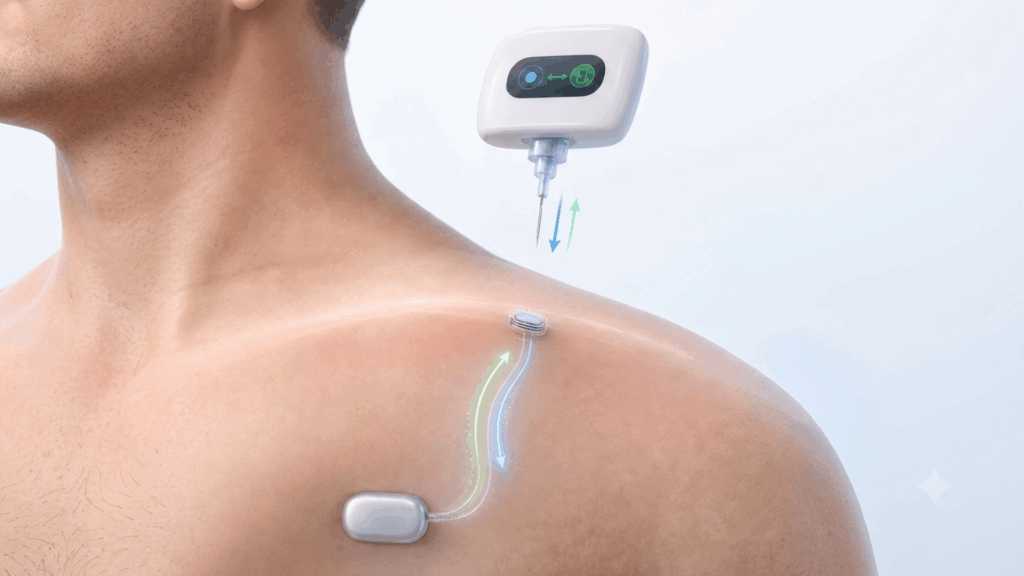
- UC Irvine researchers develop hidden charging interface for long-term implanted medical devices
- Needle-access socket powers implants without permanently exposing electrical connections
- Researchers achieve 16 Mbps data transfers via temporary implant-needle connections
An ongoing challenge in bioelectronics is that exposed sockets invite microbial infection, while wireless charging antennas remain bulky.
Researchers at the University of California, Irvine have developed an implantable power outlet that remains under the skin and is accessible via a simple needle insertion.
Called the Implantable Bioelectronic Outlet (IBO), the device remains under the skin until electrical access is needed for charging, maintenance or data retrieval.
Latest videos fromTechRadar
A three-tier memory architecture built around SSD offloading
Researchers describe the implant as a general access point compatible with sensors, neural interfaces, stimulators and battery-powered systems already used in medicine.
The device consists mostly of soft spongy plastic containing pores of approx. 150 micrometers wide, which can be compared to a very fine needle diameter.
The sponge was first dipped in a highly conductive polymer, coating its pores with a layer between 100 and 200 nanometers thick.
They then applied a silicone rubber solution to form a protective, electrically insulating jacket around the outer surface.
Several sheathed sponge layers were sandwiched between unmodified sponge layers and completely covered with silicone rubber to complete the module.
According to Hyung Joon Shim, a postdoctoral fellow in electrical engineering at UC Irvine, the device remains completely under the skin between uses.
A needle is inserted only when electrical access becomes necessary and removed immediately thereafter.
In tests on mice and rats, researchers linked the sockets with neural interface implants to recharge batteries and transfer data.
Data transfer reached nearly 16 Mbps, matching the maximum possible speed of the implants during these experimental sessions.
Separate pig experiments paired the outputs with stimulation implants that delivered 20 microamp electrical pulses lasting 100 milliseconds each over longer periods.
The porous structure resisted cracking after more than 100 needle insertions from 18 to 30 gauge.
Moving from laboratory results to real-world applications
The implanted outlets remained in the mice for over a year without degrading or causing visible complications.
Jennifer Gelinas, associate professor of pediatrics and anatomy and neurobiology at UC Irvine, said long-term safety is among the most critical requirements for any implantable technology.
Since experimental animals were anesthetized during charging sessions, real-world use in awake patients would require a different needle placement.
Gelinas suggested medical tape or an adhesive dressing, similar to methods used for standard intravenous needles, could stabilize the connection point.
Passing a needle through the skin is likely to cause short-term discomfort comparable to a standard injection.
Future versions may include smaller needles, topical anesthetics, or specialized coatings designed to reduce pain and inflammation during use.
Because the outlet needle will not require a hollow channel for fluid delivery, it can potentially be made thinner than conventional injection needles.
The researchers claim that this socket could complement wireless technology, reserving pin access specifically for fast charging or large data transfers.
That said, the research team cautioned that evaluation of pain, infection risk, and tissue response across repeated access sessions remains necessary before any patient testing begins.
Follow TechRadar on Google News and add us as a preferred source to get our expert news, reviews and opinions in your feeds.


