
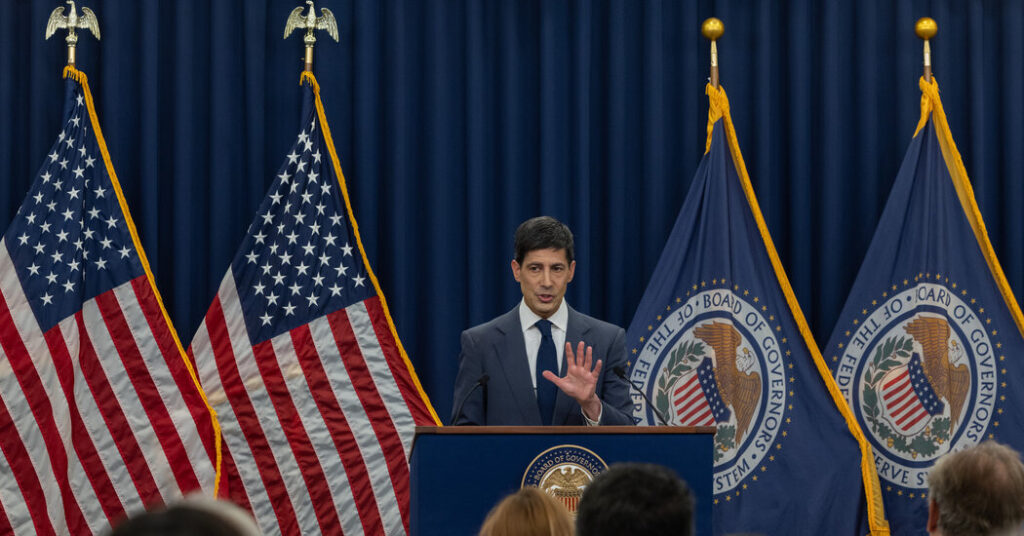
From the moment Kevin M. Warsh took the podium for his first news conference as chairman of the Federal Reserve on Wednesday, he sounded less like the head of the central bank and more like a politician.
Fresh from presiding over his inaugural policy meeting as head of the world’s most powerful central bank, Mr. Warsh put on the manner and appearance of an elected official smoothing his way through a town hall forum.
He received questions with a knowing smile. He elicited laughter. He gave long answers that were neither yes nor no. And he peppered his answers with the kind of jargon that seemed more suited to a boardroom than a Fed news conference.
He spoke of “first principles” and trumpeted the brevity of Wednesday’s Fed policy statement. He talked about “alternative frameworks” and the Fed’s “mandate.”
“Change is not easy,” he said. “Change is fraught with risk.” He conveyed his hope that “we can put some points on the board.”
At one point he said artificial intelligence was “perhaps short for American ingenuity” — an idiom that wouldn’t have been out of place in a stump speech.
He even had a clear catchphrase.
“We have a task force on that,” he said in response to a question about AI, referring to groups he said he created to study topics including Fed communications and data sources.
Could the chairman give his view on how much the interest rates were weighing on the economy? “We also have a task force in that area.”
Still, it was remarkable that Mr. Warsh held a press conference.
He has promised “regime change” at the Fed that extends to the way the central bank communicates. He has suggested its policymakers are talking too much and has criticized the bank’s tradition of indicating where it sees interest rates headed.
At his Senate confirmation hearing in April, Mr. Warsh did not hold press conferences after each political meeting, although he stopped short of arguing for a reduction. Fed chairmen have held scheduled news conferences after policy meetings since 2011.
“Truth-seeking is more important than repetition,” said Mr. Warsh at his hearing. “If you have a press conference, you want to deliver some important news.”
Mr. Warsh, who was a Fed governor from 2006 to 2011, made some news on Wednesday. He said he was the Fed official who did not submit a set of projections for the “dot plot,” which tracks what policymakers think will happen to borrowing costs in the future. He promised that the Fed would focus on providing “price stability.” He announced the formation of his task forces.
Many opponents had feared that Mr. Warsh would be President Trump’s “sock puppet” there to do the president’s bidding and lower interest rates on demand. It wasn’t a takeaway on Wednesday.
Instead, it was Mr. Warsh’s jocular jujitsu that was perhaps more striking.
It was a marked departure from his immediate predecessor, Jerome H. Powell, who as Fed chairman was known for his regular communication. During one of his first news conferences, in 2018, Mr. Powell promised to provide a “plain English overview of how the economy is doing, what my colleagues and I at the Federal Reserve are trying to do, and why.”
Mr. Warsh seemed to delight in obfuscation.
He declined to say what he thought should happen to interest rates or how exactly the Fed would bring down inflation, which has remained well above the Fed’s 2 percent target for five years. Asked about renovations at Fed headquarters, which Mr Trump has vociferously attacked and which led to a criminal investigation of Mr Powell, Mr Warsh said little beyond a general need for the Fed to be “good stewards of taxpayers’ money”.
When Mr. Warsh, fielding a question from a reporter about how patient he thought the Fed might be with inflation, appeared to stifle a laugh. “Quite a bit there,” he allowed. “Let me try to break it.”
“I’m glad they practice giving you two questions, because my answer to your first question was to be very short,” he replied after another query. “I have nothing more to say than the statement itself.”
“I don’t want to predict the outcome,” he said again and again.
His demeanor struck some Fed watchers as elusive, though there were also admissions that he seemed pleasant for a rookie.
“It wasn’t a short press conference,” said Christian Hoffmann, head of fixed income at Thornburg Investment Management. “I think he very much likes communication on his own terms.”
And Mr. Trump, for now, seemed to like what he saw.
Speaking to reporters after Mr. Warsh’s press conference, Mr. Trump lukewarm on Fed’s decision to keep interest rates steady. But he was more generous to his new Fed chairman.
“We have a very good fellow over there now,” said Mr. Trump, “so I’m guided by what he wants to do.”
Lydia DePillis contributed with reporting.


