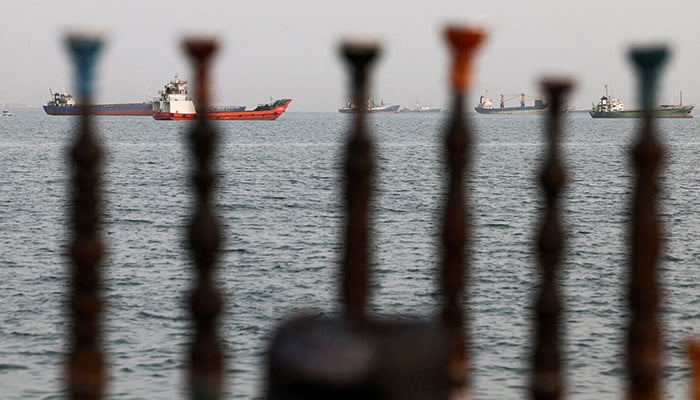
More than three months after the US and Israel launched a war against Iran, there are renewed hopes that the conflict may soon come to an end.
The war has affected not only the countries directly involved, but also the global economy, as the closure of the Strait of Hormuz has pushed oil prices to historic highs, led to inflation and hampered economic growth worldwide.
Pakistan, the main mediator, has stepped up its diplomatic efforts in recent days, with Interior Minister Mohsin Naqvi and Chief of Army Staff (COAS) and Chief of Defense Forces (CDF) Field Marshal Asim Munir visiting Iran.
Following this development, Donald Trump said that Washington and Tehran had “pretty much negotiated” a memorandum of understanding on a peace deal that would lead to the reopening of the Strait of Hormuz.
While global leaders issued statements following these developments, details are emerging of the proposed deal that would see an end to hostilities.
Following are the details that have been reported so far:
- Axios says the US and Iran are close to signing a deal involving a 60-day ceasefire extension.
- Axios says during this period that the Strait of Hormuz will be reopened.
- Axios saying that Iran would be able to freely sell oil and that negotiations would be held to limit Iran’s nuclear program.
- Axios saying for a time that the strait would be open without tolls and Iran would agree to clear the mines it laid in the strait to allow ships to pass freely.
- Axios in return, says the US will lift its blockade of Iranian ports and issue some sanctions waivers to allow Iran to sell oil freely.
- Iran’s Tasnim News agency says in a potential MoU between Iran and the US, Washington will waive sanctions against Iran’s oil.
- Tasnim says the MoU emphasizes the end of war on all fronts, including Lebanon.
- Tasnim says that a 30-day period will be set aside for procedures related to the Strait of Hormuz and the end of the blockade.
- Tasnim says a 60-day period will be set for nuclear talks.
- Tasnim says Iran has yet to agree to any actions on its nuclear issue.
- Tasnim says according to the potential MoU with the US that part of Iran’s frozen funds must be released in the first phase.
- Tasnim says that Iran has stressed that any initial MoU is conditional on the release of at least part of these assets in a way that allows our country to access them.
- Tasnim says that the mechanism for releasing the second part of frozen assets must be specified during the negotiation process.
- Tasnim says that if an agreement is reached with the United States, the state of the Strait of Hormuz will not return to the pre-war state.
- Tasnim says the number of ships able to pass through the Strait of Hormuz will return to pre-war levels in a 30-day period.
- Tasnim says that Iran emphasizes the exercise of its sovereignty over the Strait of Hormuz in various ways, the details of which will be announced.
- Tasnim says the naval blockade must be completely lifted within 30 days, according to the understanding.
- Tasnim says that if the naval blockade is not lifted, there will be no change in the Strait of Hormuz.
- Tasnim says any change in passage and navigation through the strait is contingent on the US implementing other commitments in the memorandum of understanding.
- Tasnim says the US commitment to withdraw its forces from Iran’s enclave is another point Tehran emphasizes in the potential MoU.
- Tasnim says the conflict over two or three clauses in the MoU between Iran and the US is still ongoing.
- Tasnim quoting a source with knowledge: If the US continues to create obstacles, there will be no possibility of reaching a final understanding.
— Additional input from Reuters