
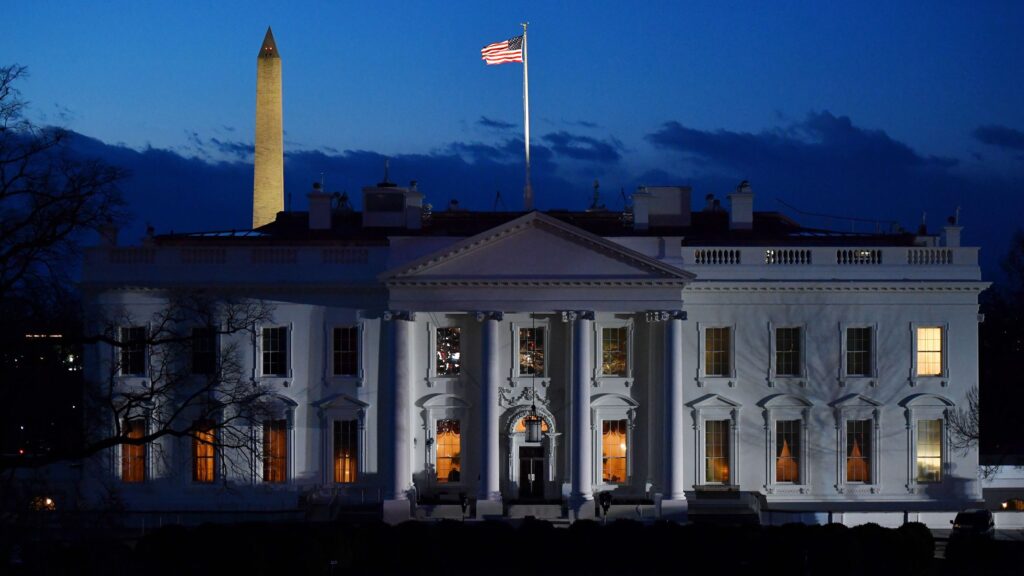
- The White House wants to reallocate hundreds of billions of dollars in federal funding away from universities and peer-reviewed research panels
- The funding will instead go to individual scientists and AI-native labs
- The plan’s credibility is undermined by the US government’s achievements in science and artificial intelligence
The Trump administration has unveiled plans to shift about $200 billion in research funding to individual scientists and a ‘national AI for science initiative’.
The move would pull funding from university research and ‘slow’ consensus peer review panels in a bid to stay ahead of China, which is making strides to catch up with AI and quantum computing technology.
The plans were laid out in a new report, called ‘Science: A New Golden Age’, presented to Donald Trump by the assistant to the president and director of the White House Office of Science and Technology Policy (OSTP), Michael Kratsios.

Funding must be shifted to artificial intelligence and individual researchers
Peer-reviewed inquiry has been the bedrock of American research since the end of World War II, but Krastios says science must once again be reinvented in a way “that frees American scientists to do their most cutting-edge work, reinvigorates the national pursuit of ambitious scientific missions, and positions the United States to lead the AI-driven revolution that will define the next century, that will define the scientific revolution.”
The report is a proposal for the direction the Trump administration wants to shape the future of federal funding for science, but the federal funding budget is signed by Congress.
The point of peer reviewed research is to prevent research from being conducted in an echo chamber, to detect errors and misinformation, and to provide criticism of research methodology and bias. By moving away from peer review and placing funding with individual scientists (likely vetted by the government to make conclusions that toe the party line), this shift in how academic research is conducted will undermine America’s scientific credibility both at home and on the global stage.
The report also suggested giving full funding to the ‘Genesis Mission’, which seeks to unite “national laboratories, industry, academia and more to harness AI for breakthroughs in energy dominance, discovery science and national security” by creating “AI-native scientific institutions better suited for an era of machine-enhanced research.” There are obviously use-cases for AI in science, but the US government doesn’t have the best track record of using AI for science.
The US government has already been caught in the past using artificial intelligence to create documents presented in hearings, where a research report presented by US Health Secretary Robert F. Kennedy Jr. is riddled with errors and cites studies that didn’t exist – a classic case of AI hallucination.
Trump has also made significant departures to the direction of climate science in the United States, with peer-reviewed authoritative assessments of the US national climate being deleted from US government websites, the US withdrawal from the Paris Agreement, along with funding and staff cuts across the National Oceanic and Atmospheric Administration, the Mauna Loa Observatory and several climate monitoring centers.
To maintain the frontline of AI development, the US is also experiencing a mass deployment of AI data centers to provide capacity for the use, training and development of frontier models. But this has presented a major challenge in providing enough power to sites already running as well as planned sites that will require multi-gigawatt connections.
Trump has encouraged AI companies and data center developers to lean into fossil fuels to provide extra energy capacity, with many AI campuses installing natural gas-burning turbines. Some of these sites operate at noise levels equivalent to an international airport 24 hours a day, seven days a week, with local residents reporting illnesses and symptoms such as vertigo, nausea, dizziness and sleep disturbances as a result of the infrasound emitted from the turbines.

Follow TechRadar on Google News and add us as a preferred source to get our expert news, reviews and opinions in your feeds.


