
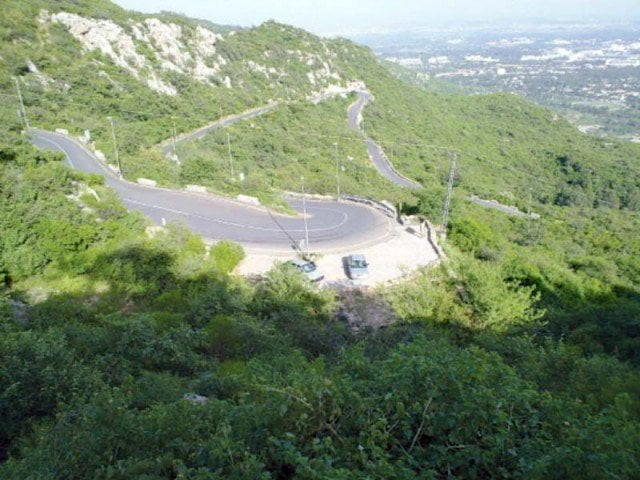
Raises concern over reported plans for hotels, sports facilities and other infrastructure in Margalla
CDA says official suspended for failure to curb Margalla Hills encroachment. PHOTO: FILE
The World Wide Fund for Nature (WWF) Pakistan on Friday expressed “serious and escalating concern” over ongoing and proposed development activities in areas adjacent to the Margalla Hills National Park, warning that they could cause “potentially irreversible risks” to the capital’s fragile ecosystem.
In a detailed statement on X, the organization said recent assessments of tree removal and land clearing in Islamabad indicate large-scale vegetation clearing and infrastructure expansion across several locations in the federal capital.
WWF-Pakistan expresses serious concern regarding ongoing and proposed development activities in areas adjacent to Margalla Hills National Park, particularly within ecologically sensitive foothill zones.
These activities pose significant risks to one of Islamabad’s most… pic.twitter.com/rH4HUfwlRe
— WWF-Pakistan (@WWFPak) April 24, 2026
It said the Margalla Hills National Park and surrounding habitats represent a “critical ecological landscape” that serves as the “lungs and natural water filter of the capital”.
“Development activities in the immediate vicinity of the park … pose serious and potentially irreversible risks, including habitat fragmentation, disruption of wildlife movement corridors and degradation of essential ecosystem services,” the statement said.
WWF-Pakistan warned that ongoing road widening, land clearing and infrastructure work, including along the Margalla Enclave Link Road, had already caused “measurable ecological degradation”.
While acknowledging that some clearing may involve the removal of invasive species, it said the scale and pattern of activity “strongly indicates wider development-driven impacts”.
The statement comes two days after the interior ministry said a meeting chaired by interior minister Mohsin Naqvi at the Capital Development Authority (CDA) headquarters decided to develop a new park spanning 1,000 acres at the foothills of the Margalla Hills in Islamabad.
نیا پایرک تعمی منیا پیرک تعمی مین آلاماباد
Federal Minister of Interior Mohsen Naqvi کی زیر کسدیر سیدا هیدکوارتارز میڨ دیکم
At the meeting, current and future projects in the federal capital were reviewed pic.twitter.com/GSEMF6vok0— Ministry of Home Affairs GoP (@MOIofficialGoP) 21 April 2026
The meeting also reviewed in detail ongoing and future development schemes in the federal capital, such as five-star hotels, which would be built under joint ventures with internationally renowned firms, the ministry said in another statement.
Making Islamabad an ideal city where facilities of international standards will be provided to the public, Mohsen Naqvi
वियाव स्टार एजे जेजें the meeting is decided— Ministry of Home Affairs GoP (@MOIofficialGoP) 21 April 2026
The organization raised further concerns over reported plans for hotels, sports facilities and other infrastructure in the Margalla foothills, saying there was limited public disclosure of environmental impact assessments and insufficient stakeholder consultation.
“WWF-Pakistan, along with other stakeholders, remains concerned about the limited availability of publicly published environmental impact assessments,” it said.
The group called on the authorities, including the CDA and the Islamabad Wildlife Management Board, to designate strict “no-go zones” in and around the park where development would be prohibited.
Read also: IHC orders CDA to stop tree felling in Islamabad amid public outcry
It also called for all proposed projects outside these zones to undergo “comprehensive, independently audited environmental impact assessments” with full disclosure.
WWF-Pakistan further demanded the immediate suspension of all ongoing and proposed development activities in sensitive foothill areas until a transparent environmental review is completed.
The organization said it remains committed to supporting a “science-based and environmentally responsible way forward” for the protection of the Margalla Hills.
On 17 April, the CDA lawyer informed the Islamabad High Court that 12,800 paper mulberry trees had been removed from F-9 Park, citing health reasons, as paper mulberry has been a major cause of allergies and every year during spring, hospitals are filled with patients with respiratory problems.
However, the sudden and large-scale nature of the cutting has caused public outrage and raises questions about whether the city’s natural heritage is being sacrificed in the name of public health.
Field inspections from December 2025 to January 2026 highlighted massive clearing along the H-8 Islamabad Expressway, Margalla Enclave Link Road and Shakarparian, leaving large tracts of exposed soil and incomplete restoration.
A WWF-Pakistan report from last year revealed gaps in transparency, site-specific planning and monitoring, raising doubts about the true intent behind the removals.


