
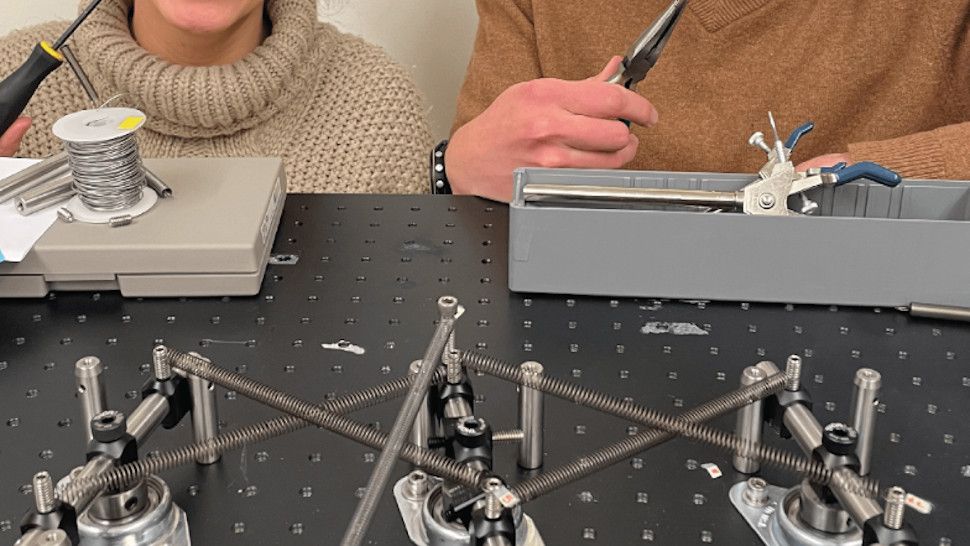
- Researchers in the United States have built a mechanical computer
- It is made of metal rods and springs and is capable of basic computer operations
- This could pave the way for important technological advances and ‘could help improve people’s lives by having more responsive artificial limbs or tactile spaces’
Can you build a PC out of springs and metal rods that works completely mechanically without electricity? No, of course you can’t, but it is possible to make such a device that is capable of basic calculations and does not need a power supply at all.
Interesting Engineering highlighted a project by researchers from St Olaf College and Syracuse University that has been published in the scientific journal Nature.
The paper, titled ‘Mechanical hysterons with tunable interactions of general character’, describes a mechanical computing platform that uses linked steel rods and springs.
The article continues below
Joey Paulsen, associate professor of physics at St Olaf College, explains: “We typically think of memory as something in a computer hard drive or in our brains. But many everyday materials retain some form of memory about their past – for example, rubber can ‘remember’ how far it has been pressed or stretched in the past.
“The research team wanted to understand if we could use everyday materials to not only remember movement, but also process information – or calculate.”
This is actually possible as the researchers were able to build three mechanical computers.
The first project could count (up to three) and another computer was able to determine whether it had been pushed an odd or even number of times. A third was designed to remember whether a medium or large amount of force had been applied to it, all without a battery in sight.
Rotors next, so on and up from there?
Obviously, these initial inventions are relatively basic, and while it’s impressive to build something capable of functional computing out of simple pieces of metal—which, of course, has been done in the distant past—it can leave you wondering what the point of all this is, other than the novelty of such a mechanical platform.
First, there may be a lot to build on here in terms of combining these kinds of mechanical innovations. One of the next steps forward for the researchers will be to look at scalability here. (They are now testing how the condition of one rotor affects its interaction with another rotor, with a view to adding a third).
Mechanical computing platforms can also have serious real-world applications, especially in harsh environments where traditional solutions won’t work or even survive. For example, in cases of extreme heat, a mechanical computer could function in scenarios where silicon chips would melt.
Paulsen notes, “Our findings are a step toward designing materials that can sense their surroundings, make a decision, and then respond. Often called smart materials, what we learned could help improve people’s lives by having more responsive artificial limbs or tactile spaces.”
This is not the first time that such concepts have been explored in the modern world of technology. A few years ago, researchers at North Carolina State University created a mechanical computer design that used a series of plastic cubes that were pushed and pulled to enter, store, and work with data.
Now a computer made of plastic cubes – what does it remind me of? Oh yes, the rather nifty PC built from Lego bricks from earlier this week…

The best laptops for all budgets

Follow TechRadar on Google News and add us as a preferred source to get our expert news, reviews and opinions in your feeds. Be sure to click the Follow button!
And of course you can also follow TechRadar on YouTube and TikTok for news, reviews, video unboxings, and get regular updates from us on WhatsApp also.


