
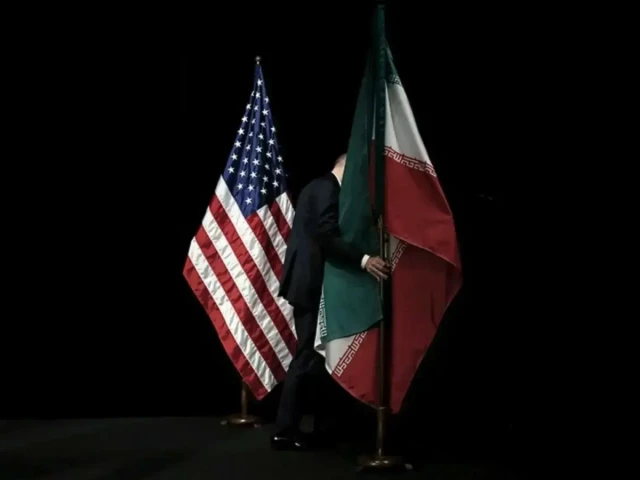
A staff member removes the Iranian flag from the stage after a group photo with foreign ministers and representatives of the United States, Iran, China, Russia, Britain, Germany, France and the European Union during Iran’s nuclear talks at the Vienna International Center in Vienna, Austria July 14, 2015. FILE PHOTO: REUTERS
ISLAMABAD:
Pakistan expressed cautious optimism on Thursday that a US-Iran deal “can be reached”, although it acknowledged that no breakthrough came from the 21-hour marathon talks held in Islamabad.
In his first formal briefing after the talks, the State Department spokesman emphasized continuity in its facilitating role, stressing that while no concrete document was finalized, the process remains firmly intact.
Tahir Andrabi described the talks as “constructive” and stressed that despite the absence of a major result, there was no collapse in the dialogue either.
“It’s very difficult to attribute inches, meters, centimeters to a metric system,” Andrabi noted when asked to quantify progress.
“Pakistan remains positive, optimistic that an agreement/understanding can be reached and we approach the process with the same positivity.”
“There certainly wasn’t a major breakthrough, but there wasn’t a collapse either,” he said.
The high level of engagement, which extended well beyond 24 hours in total attendance, reflected what officials called “intensive and extensive negotiations,” with both delegations showing endurance and commitment under demanding conditions.
“Twenty-one sleepless hours of applying your mind to complex questions was commendable,” the spokesman noted, praising the resilience of both sides.
Islamabad used the occasion to highlight its developing diplomatic footprint, positioning itself as a credible intermediary capable of maintaining the confidence of both Washington and Tehran.
According to the spokesman, Pakistan’s role did not end with the Islamabad Round but has shifted to sustained diplomatic efforts aimed at maintaining momentum.
“Pakistan’s role as a mediator and facilitator did not stop when the Islamabad talks ended. It continued,” he said.
This ongoing engagement includes high-level outreach throughout the region. Prime Minister Shehbaz Sharif and Deputy Prime Minister/Foreign Minister Ishaq Dar are currently visiting key capitals, while Chief of Defense Staff and Chief of Army Staff Field Marshal Asim Munir visited Tehran as part of parallel efforts to maintain direct channels.
“These initiatives must be seen as part of a continuum,” Andrabi explained, adding that Pakistan would “continue to advocate for peace, prosperity and stability” while keeping lines of communication open between the two adversaries.
“We will not comment on the details,” the spokesman said, reiterating that discretion remains essential. “The attitude of the relevant parties is their trust in us. We maintain that trust and we maintain confidentiality.”
He further clarified that Pakistan’s position remains “impartial to individual views but partial to peace.”
Pakistan has also sought to expand support for its mediation efforts by keeping key partners informed. The spokesman noted that friendly countries are regularly briefed as part of an effort to build what he described as an “open peace pact.”
While welcoming support from global players, including Russia, Andrabi stressed that “the main channels of communication take place through Islamabad.”


