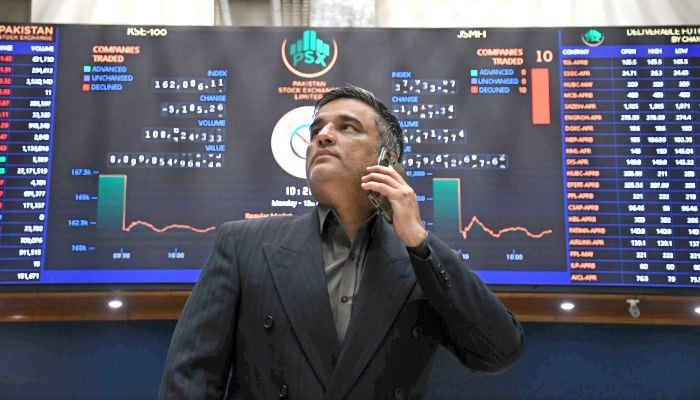
Stocks rose on Friday as investors chased the upside of fresh optimism that a deal to end the war in the Middle East could be within reach, with risk appetite further lifted by hopes of a broader diplomatic thaw.
The Pakistan Stock Exchange’s benchmark KSE-100 index traded between a high of 173,444.89 (up 3,532.94 points or 2.08%) and a low of 170,758.25 (up 846.30 points or 0.50%) from its previous close of 169.9.
“Expectations of a deal in the Middle East and the constant diplomatic shuffle are creating a sense of FOMO among investors who are rushing back to build positions ahead of the possible good news,” Ahfaz Mustafa, chief executive officer (CEO) of Ismail Iqbal Securities, said in a statement to Pakinomist.tv.
The mood improved after US President Donald Trump struck an upbeat tone, saying it “looks very good” that Washington could strike a deal with Iran and that talks could resume this weekend. He also claimed that the deal would include the opening of the Strait of Hormuz, although Iran has given no public indication that it would surrender its stockpile of enriched uranium.
US Defense Secretary Pete Hegseth earlier took a harder line, warning that if Iran “chooses badly” it would face a blockade and attacks on infrastructure.
Bloomberg reported that some Arab and European leaders in the Gulf fear a viable deal could take months and have called for the ceasefire to be extended, pushing for Hormuz to reopen quickly amid concerns about wider economic fallout.
Markets also drew some comfort from a 10-day ceasefire between Israel and Lebanon that came into effect on Thursday, although the durability of the arrangement remains uncertain.
On the domestic front, Pakistan’s current account surplus widened to $1.07 billion in March from $231 million in February, supported by a lower trade deficit on goods and services and robust remittances, according to State Bank of Pakistan (SBP) data released on Thursday.
The surplus fell 16% year-on-year and on a cumulative basis, Pakistan recorded a current account surplus of $8 million in 9MFY26, down from $1,674 billion in the same period of FY25. The data followed Pakistan’s receipt of funds from Saudi Arabia, which has helped bolster foreign exchange buffers ahead of an upcoming loan repayment to the United Arab Emirates (UAE).
In the previous session on Thursday, the index gained 1,392.01 points (0.83%) to close at 169,911.95, after hitting an intraday high of 170,899.16 and a low of 168,941.31.