
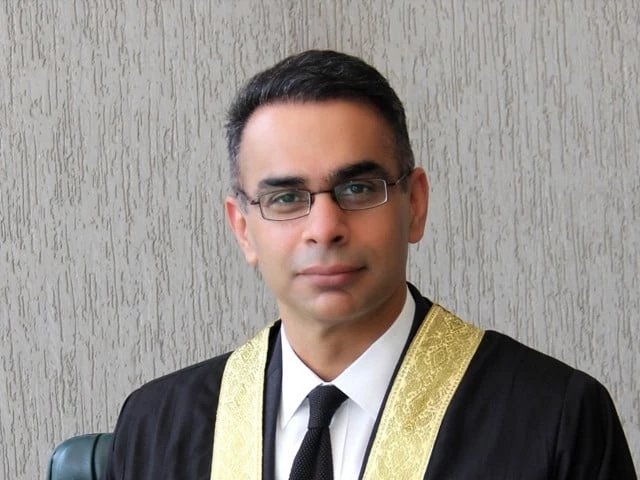
Justice Sattar says amendments to Articles 200 and 209 are designed as a weapon to whip judges into submission
ISLAMABAD:
Justice Babar Sattar, who has been transferred from the Islamabad High Court to the Peshawar High Court, has warned that the transfer of judges would have a chilling effect on the remaining vestiges of independence within the judiciary.
Before a meeting of the Judicial Commission of Pakistan (JCP) regarding the transfer of IHC judges, Justice Sattar wrote a letter to the commission requesting to grant him the right of hearing before approving his transfer. However, his request was not granted by the commission.
It is learned that Justice Sattar in his letter had warned the JCP that the transfer would be detrimental to judicial independence.
He also said that the weaponization of judicial transfers will foster a culture of impunity within the judiciary where chicanery and mediocrity will thrive.
Justice Sattar said amendments to Articles 200 and 209 are designed as a weapon to whip judges into submission.
He warned that now judges could be threatened with transfer to other places and in case they refuse to accept the transfer, they will face criminal consequences.
According to Justice Sattar, even General Ziaul Haq’s regime did not prescribe such method of transfer of judges.
He said the decision to transfer from the ruling regime would set a dangerous precedent and turn the judiciary into an actor that could be seen as promoting an oppressive kleptocracy.
He also said that judicial history is replete with unflattering accounts of complicit judges who, driven by nefarious ambitions, used the doctrine of necessity to play second fiddle to the Praetorians.
It is not that in times when authoritarianism grew and the enforcement of fundamental rights was curtailed, the judges at the helm were unable to distinguish right from wrong.
He said that the weaponization of judicial transfers will promote a culture of impunity within the judiciary where chicanery and mediocrity will thrive and it will become impossible to attract and retain useful human resources within the judiciary that are essential to maintaining a rule of law-based justice system.”
Justice Sattar said his concerns are that the weaponization of judicial transfers is not for personal affront. The proposed arrangement would create an inherent conflict for judges, who are required by the constitution to take an oath to dispense justice “without fear or favour, affection or ill will”. Judges are people. With the sword of Democles hanging over them, the safe choice for them will not be to do what is right, but what they are told to do by whoever has the most power.
Justice Sattar agreed with CJP Yahya Afridi’s reasons against judicial transfer. He also said that it appears that the proposed transfers are based on mala fide considerations.
He also referred to the six IHC judges’ letter written to the Supreme Judicial Council seeking guidance on agency interference in judicial functions.
“There have also been comments that the six-judge letter remains an unforgivable sin that must be atoned for. One of the six IHC judges has since been removed from office by two of his peers on the IHC in an unprecedented exercise of quo warranto powers bypassing the SJC. Four of the remaining judges are now proposed to be moved out of the IHC.”
However, Justice Sattar said that considering the prevailing ethos and culture at the IHC, the transfer may be a boon for him. But the issue of transfers and the considerations that underlie them will have devastating institutional effects on the judiciary.
Security of tenure of judges is recognized throughout the civilized world as an indispensable condition for judicial independence. If judges can be shunted back and forth due to the whims of an incumbent regime, the judiciary cannot pretend to be an independent pillar of the state. And if the judiciary is not independent enough to enforce the constitution, uphold the rule of law and act as a check on executive abuse, it loses its usefulness entirely.
Justice Sattar, however, said he would be bound by any decision taken by the JCP.


