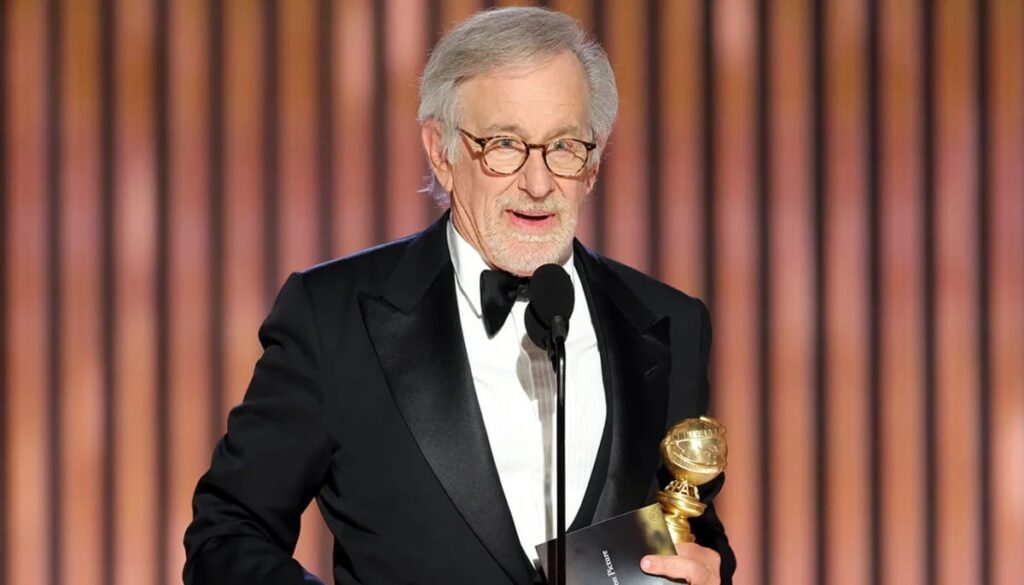
Steven Spielberg has made his position on artificial intelligence in Hollywood very clear, and there is no ambiguity about where he stands.
Talking about Michelle Obama and Craig Robinson IMO podcast, the legendary director said he has no interest in artificial intelligence playing any creative role in filmmaking, drawing a firm line between what he considers legitimate uses of the technology and what he sees as a fundamental threat to the art form.
“Where I don’t love artificial intelligence is where it takes a stand or there’s an empty chair at a writer’s table,” Spielberg said.
“I’m not willing to substitute, you know, because I don’t really believe in sensation. I don’t believe there’s any substitute for the soul. I don’t think it’s an algorithm that’s inventable… A computer that thinks it feels more than we feel is anathema to the way I was brought up and how I want to practice my own work of producing and producing.”
He was willing to give the technology some limited utility, such as helping with location searches or saving the production team time on logistical groundwork.
But the moment AI is asked to weigh in on the creative decisions that define a film, it’s completely out.
“Don’t tell me how to write my dialogue for this character. Don’t tell me where the camera should go. And don’t tell me what the set should look like, unless the AI is just a tool in a big toolbox of the production designer,” he said.
“Use AI as a tool, but don’t use AI as the last word on anything creative. That’s where I draw the line.”
Spielberg is in good company.
Leonardo DiCaprio expressed similar concerns as Time magazine in December, arguing that true art requires a human at the center and that anything produced by AI, no matter how technically impressive, lacks the anchoring that makes creative work last.
“I think anything that’s going to be perceived authentically as art has to come from the human,” DiCaprio said, describing AI-generated music mashups as instantly dazzling but ultimately hollow, brilliant for fifteen minutes before disappearing into “the ether of other internet junk. There’s no anchoring to it. It’s just brilliant.”
Two of Hollywood’s most respected voices thus arrive at the same conclusion by different paths. The soul of the film, they both argue, is not something that can be coded.