
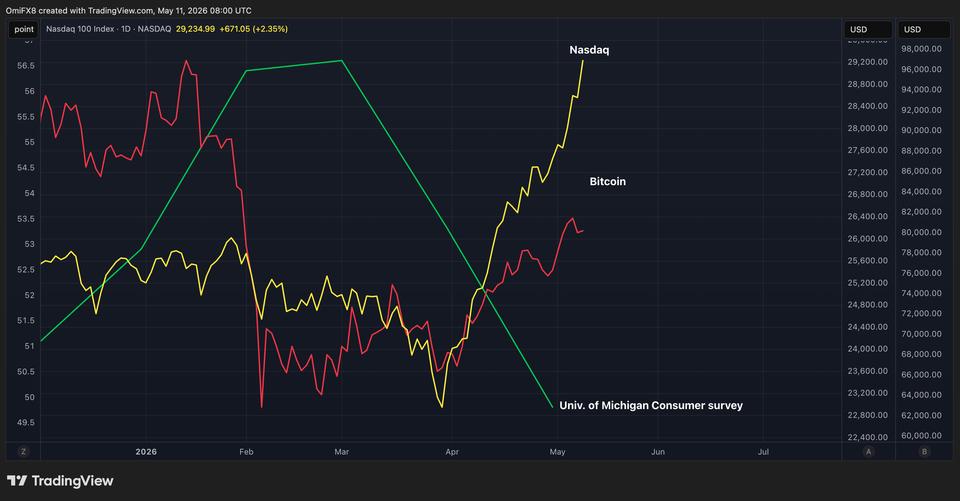
Large financial assets and the US consumer are moving in opposite directions, telling two very different stories about the US economy.
Bitcoin, the leading cryptocurrency by market capitalization and a macro asset, surged 11.8% last month, the biggest gain since April 2025, and has since extended the rally by nearly 6% to $80,700, CoinDesk data shows.
This recovery has come alongside record risk-taking on Wall Street, as the tech-heavy Nasdaq has surged 22% since April 1 to hit a lifetime high of 23,235. The broader index, the S&P 500, has risen more than 12% to 7,398 points, according to data source TradingView.
The combined rise in stocks and crypto is usually expected to lift the spirits of the US consumer, who is known to invest in both assets. Reports suggest that approximately 30% of American adults, or 70.4 million people, own cryptocurrency. Additionally, 62% of adults have owned stocks on average since 2023.
But that’s not the case, as highlighted by the University of Michigan’s closely watched survey of consumers released Friday. The survey showed a preliminary record low reading of 48.2 points, down 7.7% from a year ago and extending the decline from April’s reading of 49.8 points.
Simply put, the American consumer is more depressed than ever, and this is primarily due to fears of inflation. A third of respondents cited gas prices as the biggest concern, and another third cited tariffs.
The growing disconnect between Wall Street and Main Street reflects two very different economic realities, according to Alvin Kan, COO of Bitget Wallet.
“Institutional capital continues to flow into artificial intelligence, semiconductors and digital assets, pushing the Nasdaq and Bitcoin higher as markets price in long-term productivity growth and technological transformation. At the same time, consumer confidence remains weak as households continue to deal with inflation, high costs of living and economic uncertainty. Indeed, markets are still trading on future financial pressures,” he says. CoinDesk.
An AI capex boom and strong corporate earnings from mega-cap tech companies have fueled the Nasdaq rally, fueling demand for other emerging technologies such as bitcoin. The US-listed spot ETFs have pulled in billions in recent weeks amid the Nasdaq rally.
“This divergence is driven by strong tech earnings, sustained ETF and institutional inflows into Bitcoin, and the growing role of digital assets as both growth and diversification. It also shows how crypto is increasingly tied to macro liquidity and innovation cycles rather than pure retail sentiment,” Kan said.
Bitcoin and Nasdaq are known to share a strong positive correlation. The crypto market began as a grassroots movement that often moved independently of Wall Street and traditional financial markets. But the rapid institutionalization following the launch of spot ETFs two years ago has made its price action increasingly correlated with broader equity markets.
The shift in how investors view BTC, delinking it from Main Street sentiment, is evidence of the fading promise of financial democratization, according to Markus Thielen, founder of 10x Research.
“The democratization of finance was once one of crypto’s defining promises, yet the reality has moved in the opposite direction. Wealth remains heavily concentrated in the hands of a small minority, a trend that is even more pronounced in the US stock market, where the gains have increasingly accrued to the wealthiest participants,” Thielen told CoinDesk.
So what?
As rising costs squeeze households, it might seem natural to expect markets to adjust to the gloomy mood on Main Street. But it is not necessarily promised.
“This gap is expected to continue,” said Gracy Chen, CEO of Bitget.
She added that digital assets are increasingly deviating from traditional cycles and attracting fresh capital seeking asymmetric returns, suggesting promising long-term structural growth.
“While risks such as monetary tightening, geopolitical macro events or regulatory shifts may add pressure in the short term, the new ecosystem is maturing and becoming a core tool for diversification and active risk management in volatile markets,” she noted.


