
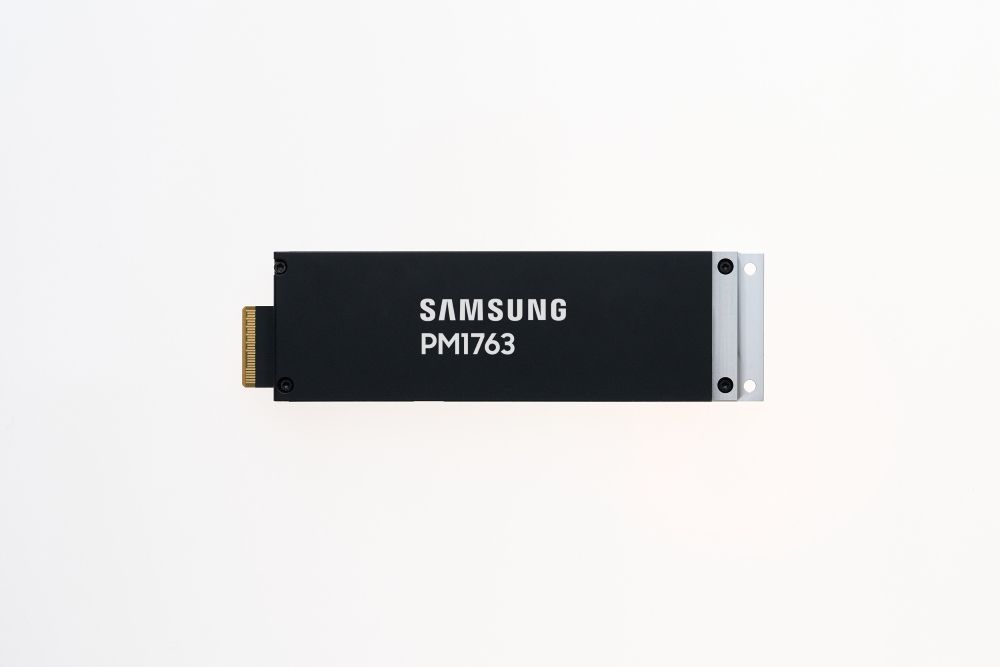
- Samsung’s PM1763 went into mass production as the fastest SSD on paper, focusing exclusively on AI data centers as its key market
- The PM1763 offers read and write speeds of 28.4 GB/s and 21.9 GB/s respectively, nearly double that of its predecessor, the PM1753
- The drive cannot be physically used in consumer PCs, adhering to an EDSFF-only form factor, while also requiring PCI-E 6.0 channels, something not yet available to end users
Samsung has announced that it is now mass producing the PM1763 SSD, which aims to replace the PM1753 as its highest enterprise class SSD for AI customers.
The PM1763 offers read speeds of 28,400 MB/s and write speeds of 21,900 MB/s utilizing PCIe 6.0 connections.
It uses the company’s 9th generation V-NAND, along with a 4nm controller, to deliver those speeds, although PCI-E 6.0 offers twice the bandwidth per path available to users.

A very fast SSD that narrowly beats the competition where it matters
Samsung’s offering is, at the time of writing, arguably the fastest SSD available to business customers on paper, but it has a few caveats.
The company claims the PM1763 offers “industry-leading performance,” and that’s certainly true in both the read and write departments, especially the latter, but it barely wins in the former over the Micron 9650.
The Micron 9650 offers read speeds of 28,000 MB/s and much slower write speeds of 14,000 MB/s sequentially, and also leverages PCI-E 6.0 to deliver such performance.
Samsung’s SSD is decidedly faster on another metric that’s key to AI customers, however: it offers 6.92 MIOPS in sequential read speed versus Micron’s 5.5 MIOPS.
However, Micron’s offering has already been in mass production since February 2026 and is expected to enjoy greater availability for the rest of the year than Samsung’s enterprise flagship.
Samsung’s offering also incorporates other gains: it delivers power efficiency that the semiconductor giant says is 1.8x better than the PM1753 and supports both post-quantum cryptography (PQC) algorithms and the TEE Device Interface Security Protocol (TDISP).
It should be noted that both Micron and Samsung’s offerings are only part of the puzzle as enterprise consumers are currently preparing for the next generation of server hardware. Both Nvidia’s Vera platform and AMD’s EPYC “Venice” offer PCI-E 6.0 connectivity, which these drives need to run at maximum speeds.
One would expect similar gains soon in the consumer market, where Samsung’s Gen 5-based 9100 Pro is one of the few that currently reigns supreme with advertised read and write speeds of 14,800MB/s and 13,400MB/s respectively, but that may be wishful thinking at best.
The gains from PM1763 are not expected to trickle down to consumers for a number of reasons. Primarily, PCI-E 6.0-supporting hardware does not currently exist in the consumer space, although data centers are beginning to adopt it.
The advanced storage on offer is also expected to be prohibitively expensive, pitting consumers against data center clients with seemingly limitless pockets for now, and industry figures like Phison’s CEO are already warning that AI demand will keep NAND and DRAM in short supply through 2026; consumer storage is increasingly built from what the data centers don’t take.
The PM1763 may therefore, at least from an end-user’s perspective, be a proof-of-concept SSD; it’s unlikely to make it onto their desktop anytime soon, and they’re unlikely to be able to afford it unless they want to host a data center-grade server at home.
The Gen 6 storage era has arrived, attached to hardware you can’t buy, in a form you can’t mount, on an interface you don’t have, built from NAND that was never going to reach you anyway. Unfortunately for enthusiasts looking for a faster SSD: the speeds are real. So is the velvet rope.

Follow TechRadar on Google News and add us as a preferred source to get our expert news, reviews and opinions in your feeds.


